
TL:DR: In The Strategy Goldilocks Sentence, I wrote that having a great strategy isn’t enough, you have to transmit it through a strategy sentence to 10X your chance of success. Leaders who learn the vernacular shorthand of their company are able to transmit strategy smoothly. Laxman Narasimhan’s strategy sentence did not speak Starbucksese, and that may had led to his quick exit.
When I joined Amazon, leaders told me that I needed to learn ‘Amazonian’ as quickly as I could – the right turn of phrase, the right words, the right timing.
One leader even said that it had taken him a few years – and many toxic meetings – to finally ‘get’ it.
This happens because we speak in words, but we hear in meaning.
The same word can have different cultural meanings.
‘Uncle’ in the West usually means a relative. But ‘Uncle’ in India is used for non-relatives, because we have assigned specific names to each relative – cacha, tau, phupha and so on.
It’s said that birds of a feather flock together. It’s also said that we become the average of the five people we spend time with.
And many of us spend upto 12 hours a day with colleagues bound by shared KPIs and calendars. We share meals, anecdotes and soon without even realising it, we start to share a vernacular and a shorthand for what we value, how we take decisions and what ideas sound ridiculous.
“Innovation” might be a regular tuesday at IDEO… new packaging at Coca-Cola .. and a new flavour for PepsiCo.
Somewhere else, it might mean higher cost and a waste of time.
People who absorb a company’s vernacular find that their ideas get approved faster, they earn trust and grow influence.
Having said that, learning a company’s vernacular shorthand by rote is not enough. You have to absorb it. Only then do you sound authentic.
Starbucks’ strategy has barely changed since the 1990s, but the strategy sentences have
Starbucks created the cafe category in the USA and its strategy has been to serve a ‘third place’ between home and work – a physical space, but also a state of mind powered by great coffee, free wifi, plug points, comfortable chairs and a loo that’s not gate-kept.
The Baristas, the jargon -tall, venti, grande, coffee you can personalise, the misspelt names, the community art, are layers of advantage that enrich the brand experience.
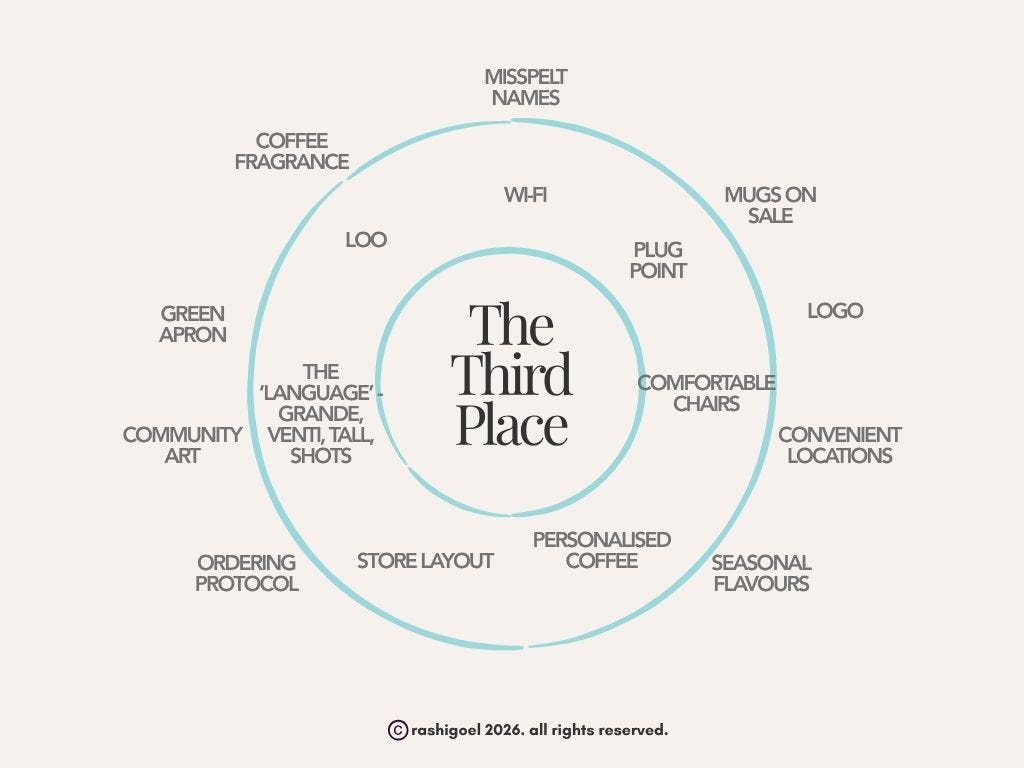
That’s it. That’s the Starbucks strategy. Simple on paper, complex to execute because of its multi-country, multi-store presence.
Over the years, a combination of missteps by Starbucks themselves and increased competitors created different strategic focus areas at different times.
And those areas of focus show up in the strategy sentences used by different CEOs.
I have mapped Starbucks’ share price against the key words from strategy sentences from different CEOs.
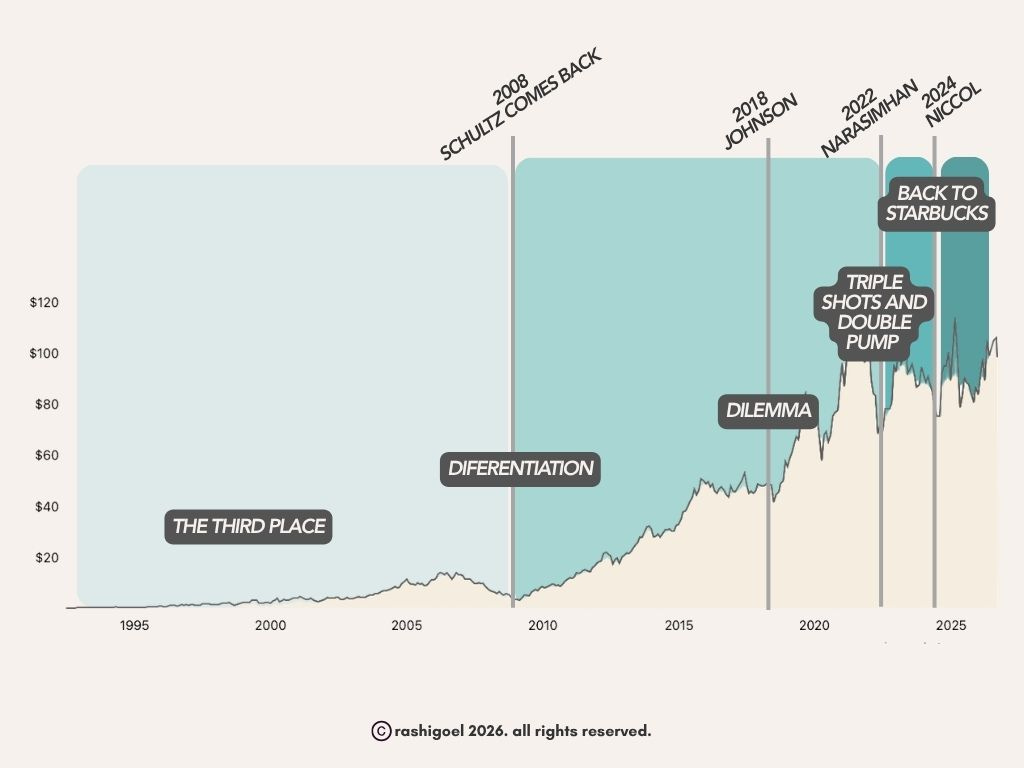
The chart shows us that –
- Each time there was a dip in share price, the CEO changed and so did the strategy sentence.
- Only one CEO’s tenure was cut short – Laxman Narasimhan’s.
Do Laxman’s key words look different to you?
Laxman was the pink sheep CEO
Laxman’s strategy sentence, “Triple shot reinvention with two pumps” had a transmission gap. These were the right priorities, but in the wrong words.
In my opinion, Laxman Narasimhan was the unfortunate Pink Sheep CEO at Starbucks. Had he been given the time to learn, or the coaching to speak “Starbucks-ese”, his strategy sentence might have been in a language employees and baristas ‘saw’, ‘felt’ and ‘got’.
A CEO who does not speak in the company’s shorthand is like a pink sheep in a flock of white. People don’t ‘get’ what they’re saying. One day, they vanish and people tell tales of, “remember there was once a pink sheep? No one understood what they said.”
Here’s my analysis of the business context, strategy focus area changed, and the strategy sentence for each CEO, including Laxman. That his language did not embody Starbucksese is clear.
2008 – Differentiation
Context: Competition intensified. MacDonalds and Dunkin’ sold great coffee at lower prices out of their already conveniently located stores. At the same time, Starbucks was opening new cafes and hiring new Baristas so fast that it was unable to embed the Starbucks experience consistently.
Strategy remained the same, focus was on the experience: Schultz came back and he knew that Starbucks did not need to copy its competition, it needed to become more of what it already was.
His strategy sentence:
Differentiate our experience, so that when a customer walks into a Starbucks store, they get something that they can ONLY get from us: the highest quality coffee in the world served by the most passionate and knowledgeable people in the industry.”
In a bold move, he sacrificed one day’s worldwide revenue by shutting down all cafes to retrain all baristas.
(Nothing signals commitment to a strategy more clearly than an interruption in business as usual and a big sacrifice.)
2018: Dilemma
Context: In the race to grow faster than competitors, Starbucks had expanded into convenient, pick-and-go places like gas stations. Instead of The Third Place, Starbucks was quickly becoming ‘Any Place’.
Strategy remained the same, focus was on restraint: Enter Kevin Johnson. He understood that Starbucks had reached critical mass. To grow further, they needed to navigate a dilemma – offer convenience, while also maintaining The Third Place experience.
“When it comes to how a retailer focuses on the customer, we see too many examples of businesses choosing between an experience that solely focuses on convenience or one that simply highlights community.”
Again, he went back to the root strength and refocused his people to grow the ‘Starbucks’ way.
2023: Triple shot reinvention with two pumps
Context: US was saturated. International expansion was difficult because of local competition. Chinese brands were entering the US and taking share.
Strategy remained the same, focus was missing: Laxman converted five must win battles into a strategy sentence.
“Triple Shot Reinvention will focus on three priorities: elevating the Starbucks brand; strengthening the company’s digital capabilities; and becoming truly global; customized with ‘two pumps’ unlocking efficiency and reinvigorating partner culture.”
The strategy may have been right, but the strategy sentence was not what people were used to.
I can almost read employees’ minds, ‘we focussed on differentiation and 2008, and on balancing the dilemma in 2018 – what do we focus on now?’
2026: Back to Starbucks
Brian Niccol essentially brought back the 2008 strategy, and he spoke perfect Starbuck-ese.
“We’ll get back to a Starbucks that’s loved for its coffee, welcoming coffeehouses and the talented green apron partners in all our stores.”
His sentence reminded everyone that the Baristas and the coffee experience they served was the meat and potatoes of the business, and they had to get back to it.
Using visible language that does not invoke meaning is strategy blindness™.
Until you embody the language system of a company, you rely on what’s visible – jargon, words, slogans.
Sometimes, you get away with it.
Most of the times you sound like an adult trying to impress Gen Z. We know just saying delulu, mid and rizz doesn’t win Gen Z over.
‘Triple shot with two pumps’ had the same problem. It used visible vocabulary, without embodying the invisible meaning that Starbucks employees had been raised on. It sounded ‘branded’, was too clever, and did not give one focus area to a vast army of employees spread out globally.
Here’s another thought that blew my mind.
The pink sheep is easy to see because it speaks differently.
But the most dangerous sheep is the one that speaks like the flock, fools them and walks away.