
Boss: Show me some concepts
Junior: Ok, about what?
Boss: About our next brand campaign
Junior: But what do we stand for? What do we want to say?
Boss: «blank stare» We’ll figure that out. You just start by looking at what other brands are doing, then we’ll decide.
This is a real conversation I witnessed between a frustrated brand manager and their boss.
It happens more often than it should.
If each time you execute, you start from scratch, it’s a sign you don’t have a strategy.
Excellent execution is necessary but insufficient, if we have an insight-based strategy that underlies all execution, the business looks right and feels right too.
For this to happen, the right conditions need to be created.
What’s more important. Strategy or execution?
Whenever I am asked to pick a side, I invariable end up borrowing Mark Ritson’s line, “I am a bothist”.
Businesses grow best when strategy and execution are like siamese twins, joined at the hip. You must be thinking, yes sure, I know this already.
But you know this intellectually. And that’s exactly what I want to change.
I want you to start ‘feeling’ it and start recognising the conditions that allow for good strategy to emerge.
We can ‘see’ execution right away, but strategy is ‘felt’.
We judge execution and strategy with the same ‘eyes’.
We shouldn’t, because execution is visible and strategy is visceral.
- Execution is LOOKED at. The campaign, the deck, the launch, the numbers on the dashboard are all visible, so, it occupies the lion’s share of our attention. That’s why it’s natural that we keep optimising this and only this.
- Strategy is FELT. It’s the narrative underneath every execution that tells us why we’re doing what we’re doing and how we will do it. It’s conviction, courage, and the belief that this is what we stand for; this will get us to win.
But life is messy.
Systems are political.
Leaders have egos.
We almost never have a perfect environment where strategy and execution are joined at the hip. You have to navigate three playgrounds to get to the ideal conditions where strategy feels right and execution looks right too.
(but isn’t)
I have tried to capture the look and feel of each of these spaces, so you can self-diagnose.
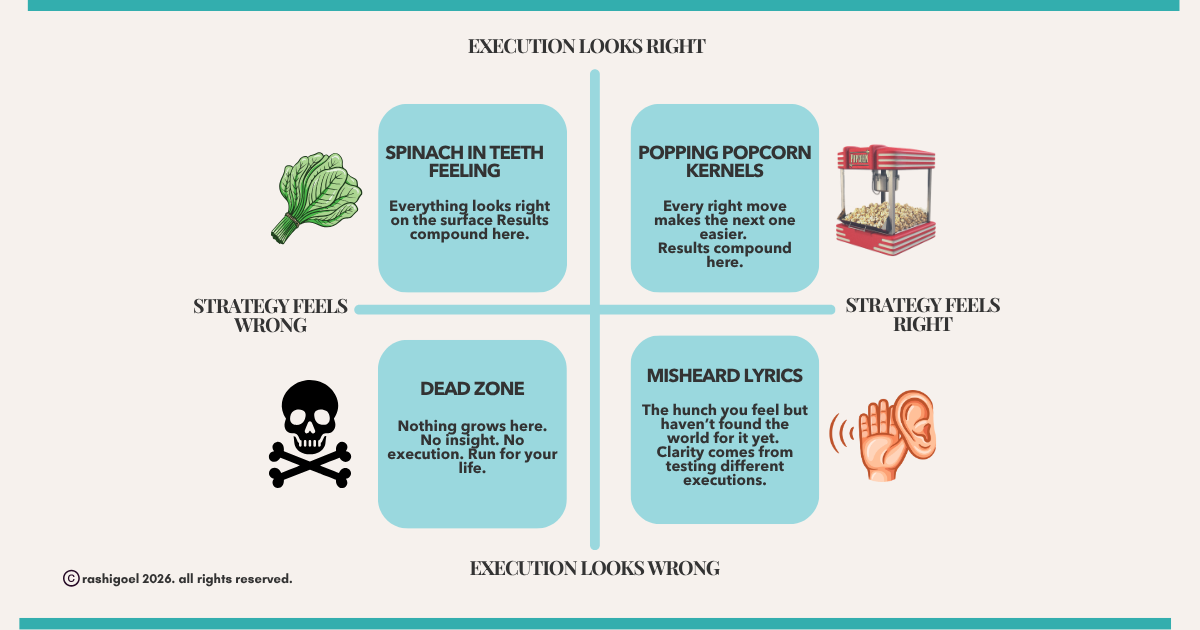
1. Spinach-in-the-teeth feeling – looks right but feels wrong
As CXOs, you are doomed if you don’t execute – because nothing kills business faster than inactivity, and doomed if you do execute – and it goes wrong.
So you keep things moving.
You green light the campaigns. Sign off on new product ideas. Assign KPIs and even rank your team on a performance curve.
Nothing looks broken. Yet, something keeps troubling you, like a piece of spinach stuck in your molars that your tongue can’t dislodge.
I have had that ‘something’s missing’ feeling far too often. And each time I came to the conclusion that we were missing an insight-based strategy.
We all have a strategy. But if that strategy is not rooted in a unique insight, even the best looking execution feels hollow.
An insight-less strategy looks perfectly logical → People want cheap furniture, so we want to be the leaders of the affordable furniture segment.
This even leads to excellent execution → reverse-engineer designs, find the cheapest vendors, sell furniture online.
But it’s also copyable. Soon, you’re caught in a downward spiral of diminishing returns, catering to consumers you’ve trained to only buy on discount, and fighting off copycats.
‘We sell cheap furniture,’ looks right but feels wrong because it only works at a surface-level, and allows execution to determine strategy, so you end up in an endless loop of diminishing returns.
2. Popping popcorn – looks right and feels right
Instead, if you flip it and start with an insight-based strategy → People don’t want cheap furniture. They want a well-designed home that does not shout, ‘I’m cheap’ → you enter the ideal zone.
And you get Ikea.
Ikea internalised this insight and allowed it to percolate into every aspect of the business – the org chart, the factory floor, the retail format, the design brief, SIMULTANEOUSLY.
- Designers made beautiful products that fit affordable price points.
- Flat-pack, self-assembly, warehouse-sized stores kept prices low.
- Store layouts allowed people to experience ikea catalogues in 3-D.
- Managers flew economy and spartan offices were cultural expressions of the insight – we don’t spend on ourselves because what we save, we pass on to the consumer.
A strategy-based execution feels and looks like popcorn kernels laced with butter and a pinch of salt in a pressure cooker. First one kernel pops, then the next, until the action compounds.
You have a bowl of delicious buttery popcorn because you created the right conditions for it → commercial actions and internal culture work together, feed into the strategy, and all three (like butter, salt, popcorn), keep making the entire system better over time.
Looks and feels right starts to feel almost effortless, the system gets into its flow zone.
3. Misheard lyrics – looks wrong but feels right
This is where most strategies get killed. When clients tell me they ditched a strategy because they did not like the script, I stifle scream and try to move them into this quadrant at least.
(If only great scripts were enough to build evergreen businesses, Vodafone and Idea would still be around.)
If you can anchor yourself to the FEELING of your strategy, then even if the execution is wrong, you don’t ditch the strategy. Instead, you root cause the execution and improve it for next time.
This quadrant feels like misheard lyrics. You know the song, you’ve heard it many times, you can feel the beats of the music, you just haven’t caught the exact words yet. So you keep trying until you get the lyrics right.
Miroslav Holub’s poem – Brief Thoughts on Maps illustrates this point better than a laborious HBR case would have.
The young lieutenant of a small Hungarian detachment in the Alps sent a reconnaissance unit out onto the icy wasteland. It began to snow immediately, snowed for two days, and the unit did not return. The lieutenant suffered: he had dispatched his own people to death.
But the third day the unit came back. Where had they been? How had they made their way?Yes, they said, we considered ourselves lost and waited for the end. And then one of us found a map in his pocket. That calmed us down. We pitched camp, lasted out the snowstorm, and then with the map we discovered our bearings. And here we are.
The lieutenant borrowed this remarkable map and had a good look at it. It was not a map of the Alps — but of the Pyrenees.
Feb 4, 1977
The unit got back to camp even with the wrong map. The map was not ‘right’ because it was not ‘on’ strategy. But it calmed the unit. It got them moving. And through the moving, they found their way home.
The strategy was the invisible WHY → we have to get back to camp. That is what a strategy actually does. It isn’t a perfect picture of the terrain. It’s the thing that gives an organisation the nerve to start walking, and the real route emerges in the doing.
Most CEOs work from this space. They know the feeling themselves, they are steering the rest of the company towards it. So they keep transmitting this feeling again and again and again, in meeting, annual reports, conferences, emails, until the daily execution catches up and the last junior most employee also feels it in their bones.
Good leaders know that it is foolhardy to aim for perfect execution on day 1. Given how complex organisations are and how difficult it is to get everyone to see the strategy the way they see it, they might (will) not always get it right the first time around.
Not many people know that Dove’s ‘Real Beauty’ launched with just billboards, not a million dollar multimedia campaign.
In my experience, even a tepid execution of a winning strategy starts to show early signs that it’s working. Savvy leaders take these green shoots to the rest of the org and get buy-in for bigger, better execution programs.
4. The dead zone – looks wrong and feels wrong
No insight, poor execution.
Everyone can see it isn’t working, but no one speaks up out of fear, politics, or fat pay checks. It is in this quadrant that we realise what are values are and if we even have any.
The real danger is mistaking quadrant 3 for quadrant 4. A misheard lyric looks identical to a dead zone, because both show weak numbers. The only difference is your instinct for insight → is there a real invisible insight that simply hasn’t been excavated properly yet?
Popcorn that became a spinach, then ended in the dead zone
Blockbuster was a well-oiled execution machine – it was in the popcorn zone for decades.
Then Netflix used technology to remove friction and made Blockbuster’s moats redundant. First, it made delivery frictionless through mail order. Then, it made access frictionless by streaming millions of titles into our home screens.
At its peak, Blockbuster employed 84,300 people worldwide and operated 9,094 stores. It was excellent at execution. But it vaporised into the dead zone anyway, because it didn’t ‘see’ underlying forces that were changing how consumers would buy and consume content.
Legacy FMCG is in the same situation. It went through its popcorn phase for decades. Even today, its execution is top class. Its managers are CEOs in the making.
Since the technology disruption, it has entered the spinach-in-teeth zone. It thinks doubling down on execution will fix an insight gap, while D2C brands are introducing consumers to new products, new formats, new content, new price points.
Legacy FMCG needs to create the ego-free, politics-free conditions for real insight to emerge and once it does, not try to squeeze it into containers of the past.