
Each of the Pandavas had one weapon of choice. Yudhishthir fought with a spear. Bheem with a mace, Nakul-Sahadev with swords and Arjun with a bow and arrow.
Even though all five were sons of the Gods, Arjun stood head and shoulders above his brothers. It is said that no one in the universe could challenge him and live to tell the tale of their valour. That’s because even though all five had the talent and the blessing, only Arjun had practised archery until he attained complete mastery.
When we practise one kick 10,000 times, we are compounding our advantage. But oftentimes, we have to stack different advantages on top of each other until our position becomes bulletproof.
Gone are the days when that initial win came from a unidimensional advantage – access to diamonds that DeBeers had, revolutionary glue technology of Post-its, the proprietary hair colour formula that Eugene Schuleller concocted, or the secret 140-year-old Coca Cola formula.
Today, when markets are choking on similar products, when technology advantages are rare or replicated within 2 years, one way to build a differentiated brand is by stacking many tiny advantages to construct one strong promise.
Much like the sword maker in Japan fuses millions of thin layers of steel to forge one flexible, but strong katana.
I share how this mental model has been applied across 3 domains that this newsletter deep dives into:
- Brand building: Pantene
- The India Playbook: Zomato
- Leadership clarity: Habit stacking
Brand building: Four layers of advantage helped P&G build Pantene into a billion-dollar business.
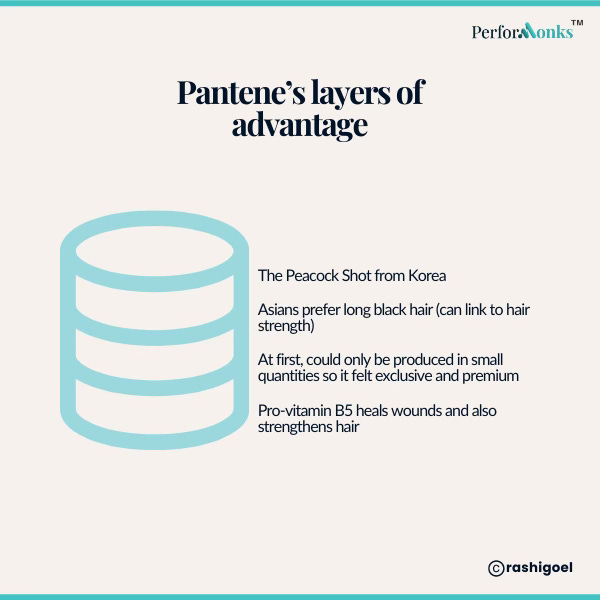
- In 1940, Swiss doctors in an ICU were using a new compound, Pro-Vitamin B5, to heal serious skin injuries. They found that this compound was also growing thicker, stronger hair where the skin had been treated. So they bottled this compound into a hair tonic and called it Pantene.
- Since it could be produced in very limited quantities, it felt exclusive, and consumers started asking for it. It entered the P&G stable when they acquired Richardson-Vicks in 1945.
- But Pantene’s fortunes remained dull in Asia. Until they discovered that Asians preferred long, black, strong hair, and they switched their advertising from the Western, individualism-laden promise of “Don’t hate me because I’m beautiful” to one focused on the functional promise of strong, black hair.
- The fourth layer is about how hair was portrayed in Pantene ads. In the West, Pantene promised hair volume and put the face in the spotlight.
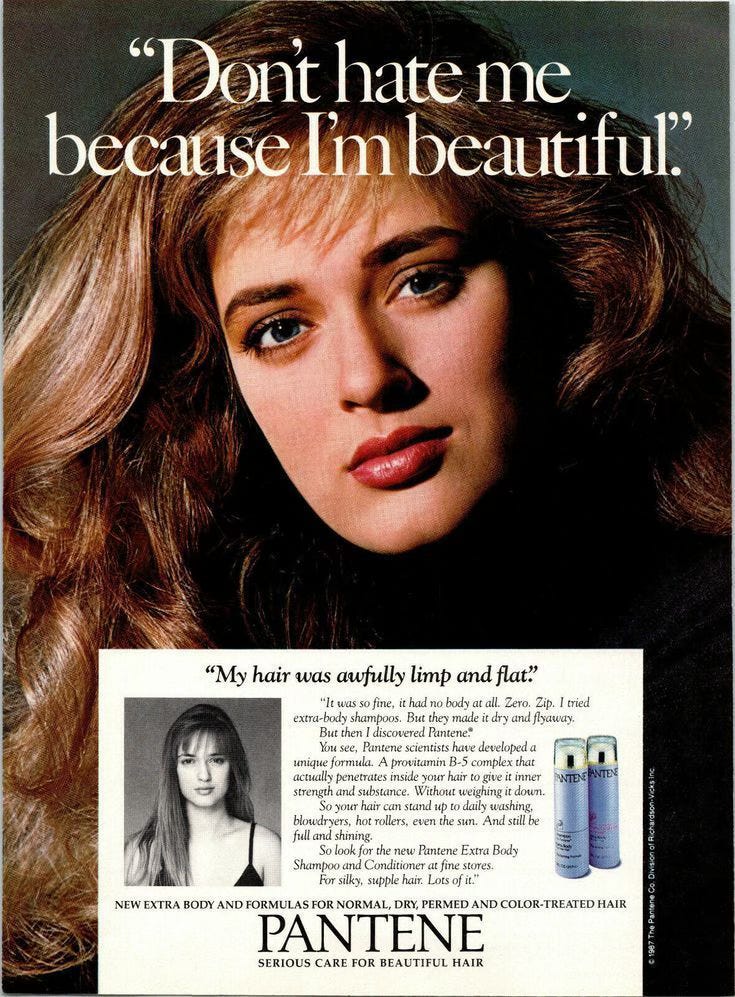
But for the Asian women, focusing on the face was too ‘forward.’ It was all about the hair for them.
Global marketers at P&G discovered the ‘peacock hair shot’ that a Korean director had shot for a Pantene ad. They recognised its potential – it took away focus from the face and highlighted hair in all its Asian glory.
ProV+Thick strong hair+Peacock hair shot – this was the winning recipe for Pantene in Asia – a market that is now Pantene’s lead revenue driver.

You see how each tiny idea builds upon the previous ones?
In hindsight, a lot of this looks like serendipity. But it took a vigilant marketer with an appetite for consuming large quantities of information to pull this off. At some point, dots between seemingly unconnected information start to neatly stack up and create an impenetrable advantage.
The India Playbook: Zomato for enterprise
In a disposable income-starved market with 17-18 million monthly transacting users, there is limited upside in pushing for household penetration. Further growth will come from depth.

The householder who orders dinner from Zomato at 9 PM on a Sunday does not turn into someone else at 1 PM by Monday.
Zomato makes it easier for your corporate avatar to order corporate meals by removing the reimbursement headache.
Leadership clarity: Habit stacking
Sun Tzu said, Opportunities multiply as they are seized. Let me adapt that – opportunities multiply as they are stacked. So do habits.
This was my best year ever of staying active. I completed 185 workouts. 102 of which were strength training. (I guess that’s where the writing mojo went!). But we all know that only when I layer this good habit with eating right will this become a true advantage. This is the macro view of stacking good habits.
James Clear explains a micro habit stacking approach. One that layers one habit on top of the previous one to create new neural connections here.
It’s a good reminder as we head into a new year.
This is the last newsletter of 2025.
The 24th. I had planned to write 52. But 24 turned out to be the Goldilocks number: 2 per month. Not too shabby.
Hopefully, I’ll write more next year.
Thanks for reading and best wishes for the New Year!
More ways to connect
- Watch my Tedx talk
- Connect on LinkedIn
- Read the Archives
- Subscribe to this Newsletter