Alex Danco wrote a brilliant series called Understanding Abundance for the tech world. Here, I learn from his thesis and apply it to the Great Indian FMCG industry.
It seems the gurus are divided.
Some believe that legacy FMCG is slowly eroding revenue like the drip-drip of a gigantic glacier, at the mercy of global warming.
Others believe that D2C is a niche play that won’t scale.
I think the answer is somewhere in the middle. Both will co-exist. But the undifferentiated middle will disappear.
The structures underlying the Great Indian FMCG industry have changed
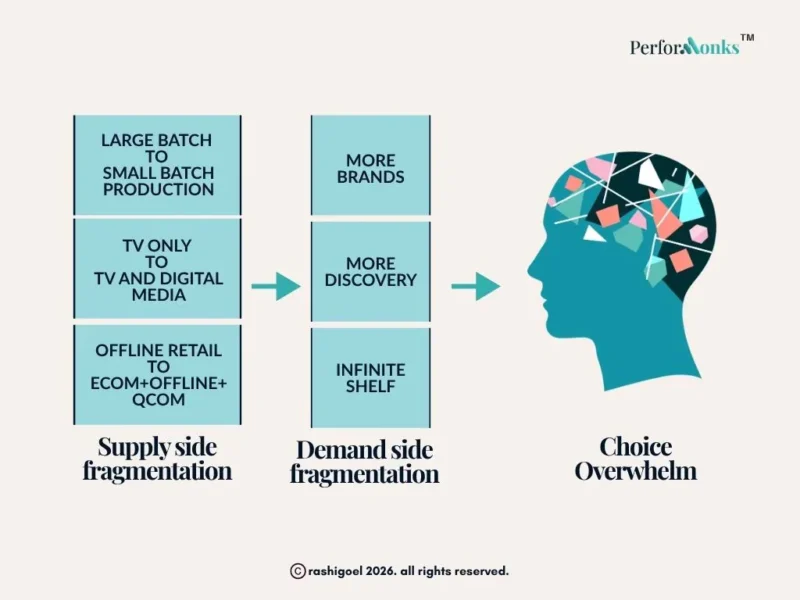
Technology has fundamentally fragmented the supply-side and demand-side layers that have supported the FMCG industry for decades and centuries.
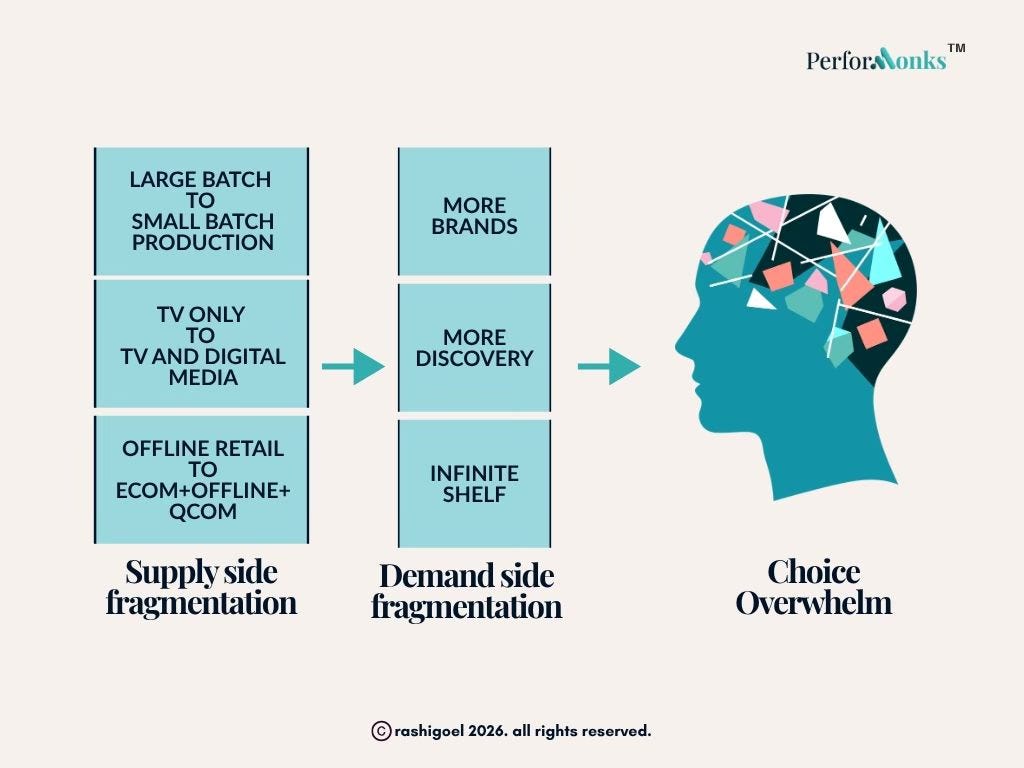
Contract R&D and manufacturing has made it easy to launch new products quickly
Ecommerce and quick commerce have made it easy for new products to sit on the retail shelf, which is now digital, hence, infinite
Digital media has made it easy to discover new products
The physical friction of shopping disappears thanks to Blinkit or Amazon. But it is replaced with cognitive overwhelm.
When the consumer is drowning in brands, her evolutionary hard wiring takes over. She simplifies and makes a binary choice – unless she gets exactly what she wants, she reverts to the safe, trusted and familiar.
I want a shampoo with vanilla fragrance that controls my frizz without making my hair sticky.
If I can’t have that, I will buy Pantene.
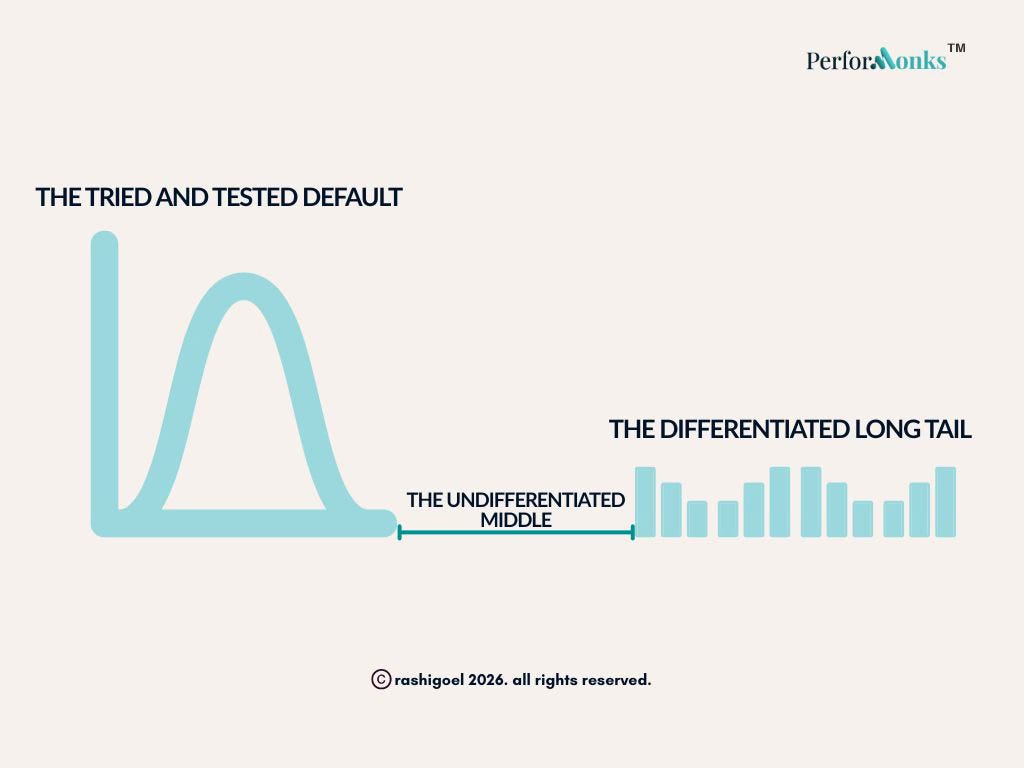
Ergo, the messy, undifferentiated middle of a thousand floral shampoos disappears.
Alex Danco calls this barbell-shaped demand.
I call it The Default and The Differentiated demand.
That’s why,
If you are planning to launch the 800th Niaciamide Serum in a Minimalist look-alike bottle,
Stop!!
You’ll fall into the Chasm of the Undifferentiated Middle.
Differentiate or default
Let’s add a bit more nuance to the differentiated long tail.
The consumer’s brain hard-codes a shortcut from the shopping aisle to the shopping cart, and often that shortcut is the familiar, tried-and-tested choice.
Lays Potato Chips, Sour Cream and Onion flavour
This hard-coding is interrupted only in two situations.
One, when she sees something so different that she wants to try it.
Noice Potato Chips, Pudina and Garlic Chutney flavour
Here, if the product lives up to the novelty, she will buy again, and your brand will live another day.
If not, do not pass go, do not collect $200, go directly to the drawing board.
The second interruption she will consider is when she sees something that’s exactly what she has wanted all along!
Super You Multigain High Protein Chips, Sour Cream and Onion flavour
The Great Indian FMCG industry was built on the assumption that distribution is all we need.
That if we managed to get more products into enough shops, in enough pin codes, we win.
Now we learn that more does not mean more.
The consumer does not choose more. She chooses less – the one that’s right for her.
One trusted default. One perfect fit. Nothing in between.
Never before has the need for differentiation been more dire! That’s for next time.
More ways to connect
- Strategy Activator Workshops — done with you.
We have a proven approach that we tailor to your context.
At the end of the process, you will have a strategy blueprint for growth. The approach has received great feedback from Harpic, Tata Salt and Tata Sampann. Click here to share your interest and I will get back to you.
- DIY Strategy Products
I am building self-serve products you can use to develop your growth strategy. Join the early list for first access.