
Survival is a zero-sum game
“Well, in OUR country,’ said Alice, still panting a little, ‘you’d generally get to somewhere else—if you ran very fast for a long time, as we’ve been doing.’
‘A slow sort of country!’ said the Queen. ‘Now, HERE, you see, it takes all the running YOU can do, to keep in the same place. If you want to get somewhere else, you must run at least twice as fast as that!”―Lewis Carroll,Through the Looking-Glass
For the longest time, we have understood evolution through Darwin’s theories – that species evolved biologically to adapt to natural enemies. The camel’s hump for drought. The polar bear’s fur for cold. Human bipedality for survival.
Until the 1970s, when Leigh Van Valen gave us another theory – The Red Queen Effect.
He said that more than forces of nature, it is other species – parasites, predators, competitors – that kill competitors or keep them from reproducing.
More people have died of infection than from floods.
When a tree falls in a forest, it is more likely because it was weakened by a fungus, not felled by lightning.
A fish that starves in a crowded pond is the victim of competition that caused food shortage.
His research proved that there is no correlation between how long a species has existed and how much longer it will survive. In other words, species do not get better at surviving over time – no matter how well they have adapted, they can never relax, because their competitors are adapting and getting better at the same time.
That’s why survival becomes a zero-sum game, because success only makes you a more juicy target for rival species, who have become better at the chase.
No matter how ahead you are, you have to keep running even to stay in the same place. If you want to start winning the race, you need to run even faster! This is the Red Queen Effect.
The same logic applies to brands competing for the same consumer.
A 50% share leader has to keep running, as does a 1% share startup.
The difference is that India is a two-queen market with complex consumer dynamics. The first Queen is in India 1, and the second is in India 2-3-4.
Today, India 1.
Next week, India 2-3-4.
India 1. The great Indian trial-and-error experiment.
Urban. Big City. Digital-first. Quick commerce. ~13+ million consumers.
This India behaves like Manhattan. I have written about it earlier.
Here, Alex Danco’s Abundance thesis applies almost as he wrote it.
Contract manufacturing and e-commerce have democratised the supply side. Today, a 16-year-old can launch a new skincare product with the same formulation as an HUL product on Amazon, by working with a co-packer in Haryana.
Social media, influencers and e-commerce have democratised the demand side. You can find a Dot and Key Super Bright Moisturiser alongside AntiNorm’s Facial in a Flash and Lakme’s Peach Milk moisturiser on the same digital shelf.
The physical friction of travelling to Yashwant Place to buy the latest smuggled skincare has been replaced by cognitive friction. Last week, I wrote how consumers cope with this paralysis of too much choice by making a binary decision
—> is this exactly what I want? If not, I will buy the safe, trusted, and familiar.
I mention Dot and Key, AntiNorm and Lakme because they are top of mind for me as I write here. Were I really in the market for a facial care product, I would definitely pick up AntiNorm because it stands out.
If I did not want AntiNorm, I would drown in this sea of lookalikes.
Identical niacinamide serums for anti-ageing.
Identical Vitamin C serums for brightening.
Identical white bottles with important-looking fonts announcing the same benefits.
It is in this environment that the Red Queen effect gets complex – not only will D2C and legacy FMCG (and local, regional brands) have to outrun each other, in parallel, they also make sure that they are running alongside the consumer.
Think of it as a three-legged race where, in some categories, she happily runs along, with her ankles tied to the same brand for decades.
In others, she tries a D2C brand that fits exactly what she needs.
If it disappoints, she unties the knots and runs to the trusted and familiar.
Or she keeps experimenting.
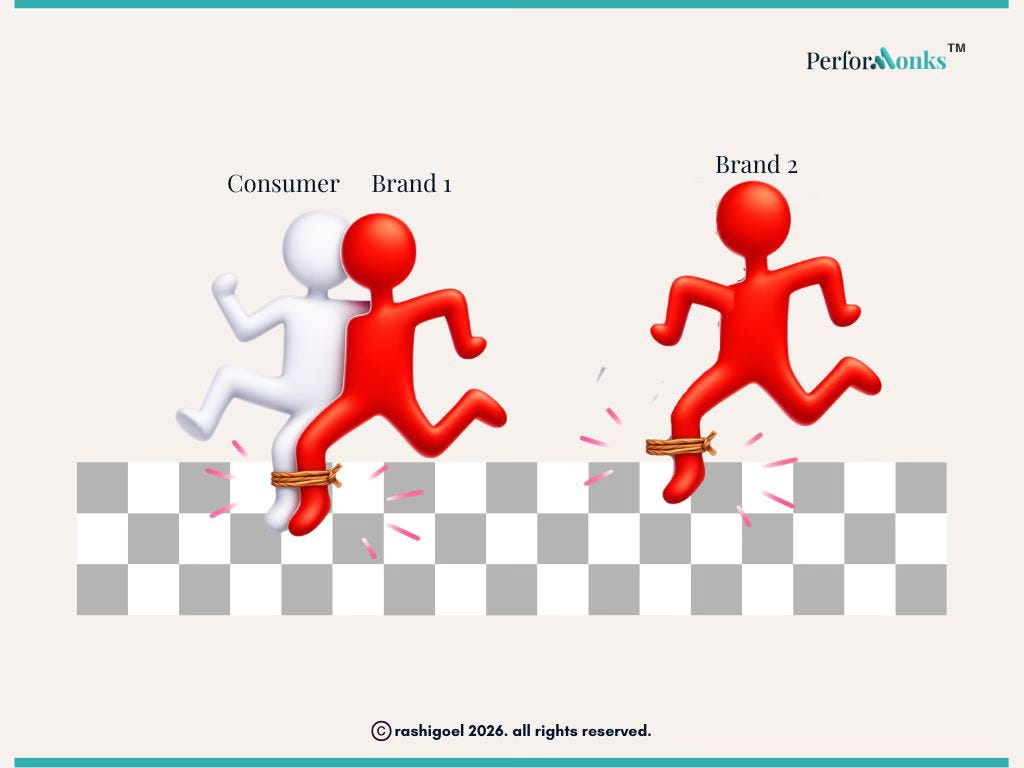
Back and forth. Back and forth. And so it goes on.
To bring this alive for you, I share a video of all my shampoo, conditioner, and hair styling products.
(They would not fit into a picture, so I had to shoot a video).
I grew up using Sunsilk. But I also have a clear memory of my frugal mom using the soap suds from my bath soap to rinse out my hair. (soap is soap, whether it comes in a bottle or a bar).
Over time, I outgrew Sunsilk. (I started finding the Sunsilk floral fragrances sooo boring, that I have not touched the brand for years.) I never tried Clinic Plus because in my mind, it is only for dandruff. When I got dandruff (rarely), I used Selsun.
Since I also colour my greys, I bought Kerastase – it keeps hair color locked in.
Then I started experiencing severe hair fall, so I also bought the hair fall conditioner from Kerastase.
My ayurvedic doctor recommended a mild ayurvedic shampoo, its bottle looks like a seat cleaning shampoo’s.
An ex-R&D leader from Unilever has launched his brand, iCosmetiques, and he assured me that this brand contains none of the baddies. It seems that even though Pantene and L’Oreal say they are sulfate-free, they do contain some hidden, not-so-great chemicals. I bought it.
I travelled to Korea and bought a curl control leave-in conditioner.
I travelled to Japan, and I bought one shampoo, one conditioner and two conditioners for hair fall.
I bought a Pantene hair fall conditioner, ‘to see if it works.’ And because it was most convenient to carry when I travelled, or showered at the gym.
I have been using As I Am co-wash for the last few years and loved it, so I bought it again. But I bought the Argan Oil variant instead of my previous Shea butter one, and this does not work as well on my hair. So I was back in the market for a co-wash. Bought Cantu, which sadly, ‘can’t do’.
Then I tried Moxie for frizz control. The product was good, but not wow enough for me to switch completely.
Last week, I discovered Nat Habit’s hair balm. And this clicked. I will now stick to this for my frizz control needs.
Yet, since I have accumulated so many other products, I will keep using them intermittently, so as to ‘not waste them’.
And I have not even covered the oils, hair colors, and gadgets yet.
Consumer business leaders are stumped.
Like cloistered 22-year-olds who have moved cities for their first job and tasted freedom for the first time, the consumer has gone rogue.
She is behaving in unpredictable ways.
This never-before-seen combination of disposable income, frictionless access and barrage of information has created a potent abundance cocktail whose blast radius has fragmented her demand moments.
Thus, the great Indian trial-and-error experiment has begun, and this consumer is workshopping their identity, beauty, lifestyle, nutrition, fashion, and even parenting philosophy by trying new products.
Many brands are benefitting from the great Indian experiment. For now.
- A few (only a few) D2C brands are winning the differentiation battle. They are different, so consumers notice them, then buy them (that’s why I picked Moxie). The real test is whether they are bought again. The most critical KPI is not LTV or CAC. It is the rate of repeat immediately after the first purchase.
- The bulk of D2C is the undifferentiated middle – the belly fat that needs Ozempic. These businesses, fattened by VC money (for now), are buying sales and moaning over CAC>LTV calculations. They might get lucky once. But, might struggle to get loyalty.
- Legacy FMCG has chosen to run the race by buying the most differentiated (and successful) D2C brands. Their core business benefits from its past equity because they are the default choice when consumers don’t find exactly what they want. But unless they shape the future, they run the risk of eroding their share in India 1.
Just the way I am done with my experimentation phase and am headed in the direction of sticking with a few brands (Nat habit, Kerastase, As I Am and iCosmetiques) for my hair care routine, one day, the dust will settle for India 1.
And the few brands that manage to stay in the basket will be the last ones still running the race.
More ways to connect
- Strategy Activator Workshops — done with you.
We have a proven approach that we tailor to your context.
At the end of the process, you will have a strategy blueprint for growth. The approach has received great feedback from Harpic, Tata Salt and Tata Sampann. Click here to share your interest and I will get back to you.
- DIY Strategy Products
I am building self-serve products you can use to develop your growth strategy. Join the early list for first access.