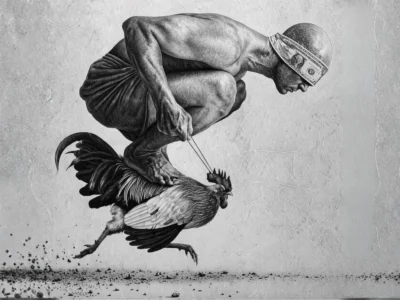
I’ve written about the forces of supply and demand-side abundance that are forcing consumers into a binary choice between The Default and The Differentiated in India 1, and how India 1’s Red Queen race plays out between D2C and legacy.
India 2-3-4 is running a different race.
Here, supply-side democratisation is much less advanced than in India 1.
The deeper you go into India 3 and 4, you see more physical retail shops (India has 12 to 19 million offline stores in total) and fewer D2C brands.
Legacy FMCG enjoys impenetrable supply-side moats that deliver a ₹1 shampoo sachet to the remotest villages in Uttar Pradesh with the ease of Tendulkar’s sixers.
So it would be easy to conclude that legacy brands are safe.
They’re not. Because the consumer in India 2-3-4 has a phone.
Just last week, Puja, a woman living in a village, went viral for unsettling the ‘elite’ because her first-world intelligence came packaged in a third-world stereotype.
Puja, powered by Jio and cheap smartphones, is the canary that’s signalling a dismantling of the gatekeepers of content and aspiration.
Even though quick commerce doesn’t exist in India 2-3-4, Amazon and Flipkart claim to serve almost all of India’s 19,300 pin codes. With ~750 million phones and ~250–300 million active online shoppers, the India 2-3-4 consumer may not be buying D2C products online yet (she’s still mainly buying phones and electronics), but she sees 30 new consumer brands on the digital shelf.
She now has a mental brand reference book that she did not have a decade ago.
This access to the latest information, new brands, and points of view is reshaping her worldview and choice architecture, yet the kirana shelf and TV screens are still speaking to an India that’s a decade old.
Look at what happened to toothpaste.
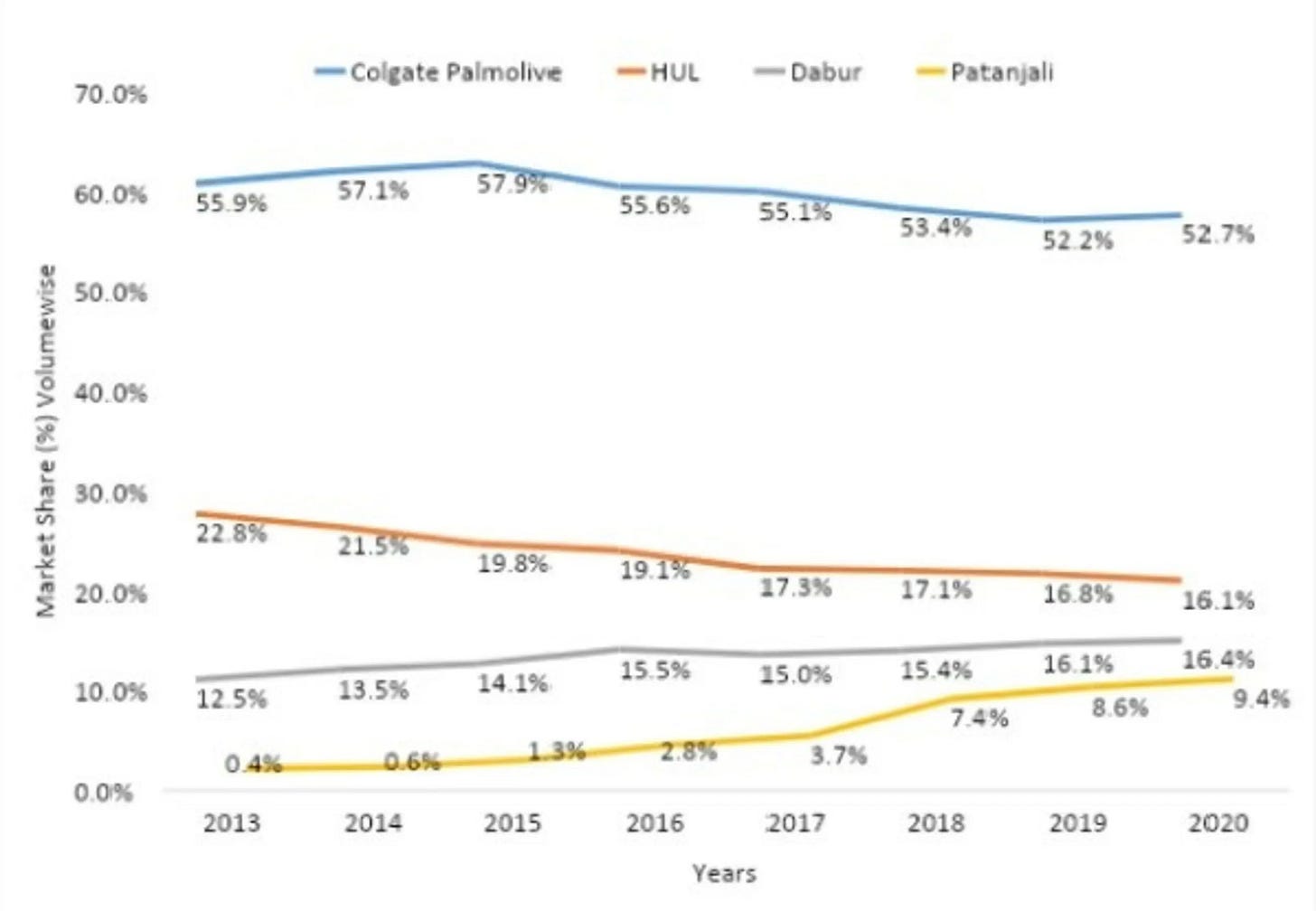
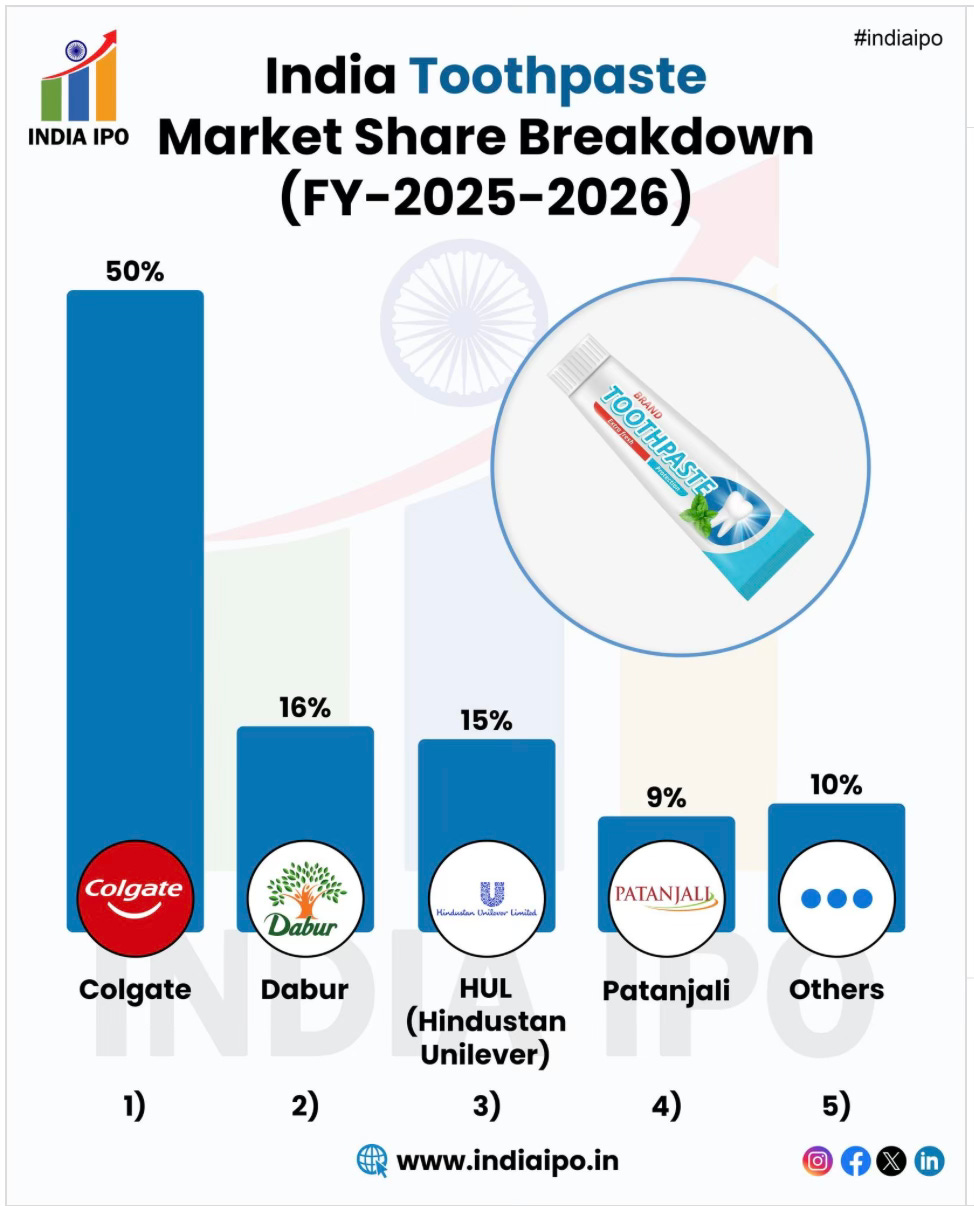
Colgate had 55.9% share in 2013. Today it is 50%. Who gained? Not another 80-year old legacy company, but Patanjali.
Baba Ramdev did not copy Colgate’s playbook.
He created new category entry points – yoga camps broadcast on TV, YouTube, and single-brand retail stores.
He reframed other toothpastes as “chemicals in your mouth”
There was a tidal wave of consumers questioning their 80-year-old toothpaste and switching to Dant Kanti almost overnight.
Ironically, Colgate had to copy Patanjali’s playbook to launch Vedshakti, an ayurvedic variant.
That was one Baba Ramdev and one category.
Now imagine this replaying across skincare, haircare, and packaged food, with a hundred D2C brands, Instagram Reels, and Amazon doorstep delivery.
The shape of demand in India 2-3-4 is not a copy-paste from India 1
Tier 3 cities already buy 43% of D2C volume and continue to grow. But legacy brands still enjoy deep trust as you enter para-urban and rural India.
The binary choice, “if not exactly this, then the familiar” — is already forming in her mind.
It just needs the full unlock of willingness, affordability and access.
While the average India 1 consumer is experimenting and trying out Matcha, Boba, Oolong and Cold Brews, India 2-3-4, even if they can afford to, are not willing to try that Matcha Latte just yet.
First, they will try that Nescafé. And they will start with the Re.1 Nescafé sachet before committing to the jar.
For large swathes of this consumer, the Re.1 sachet unlocks affordability. For the rest, it unlocks derisked trials.
The question both legacy and D2C brands should be asking is “what differentiated value does this consumer actually warm up to?”
Legacy brands will have to ‘see’ the underlying shape of this Re.1, Rs.5, Rs.10 demand – is it to derick trials or is it an affordability purchase?
While D2C will have to think of structural adjustments in their business model to de-risk trials.
Because in category after category, the consumer’s aspirations and awareness are evolving at India 1 speed while the supply infrastructure moves at India 2-3-4 speed.
The gap between her mental reference book and what she is willing to buy is decreasing every day.

The day she crosses the chasm of inertia between ‘aspiration’ and ‘familiar feels safe,’ the brand leaderboard will change — and the sheer size of India 2-3-4 will hit like a tsunami that washes away decades of trust.
But there are two blindspots that are wired into the DNA of our two athletes that can trip them.
Legacy brands over estimate trust.
Distribution depth, cost efficiency, and consistency over the last 50-years are real and precious assets.
But the consumer continues to refresh her choice architecture.
As disposable incomes and willigness to try grow, India 2-3-4 will start playing the same ping pong between legacy and D2C, back and forth that consumers in India 1 already play.
When it happens, it will catch legacy FMCG by surprise. To prevent that from happening, trust must now be re-earned. Products must be refreshed.
D2C has a business model and endurance problem.
It’s riding the early-adopter wave and growing, but not profitably. It doesn’t have the funds to replicate legacy FMCG’s supply-side moat, and since only 10–15% of FMCG is purchased online, it needs to crack offline sales to succeed in India 2-3-4 – but it does not have that high velocity SKU that offline retailers want to stock.
It needs to earn the superpowers of trust, velocity, and scale that legacy FMCG has built over decades.
So D2C’s Red Queen race in India 2-3-4 requires staying power; not ‘move fast and break things’.
The question is, can they keep running long enough for the consumer to catch up?
As someone wise once said, “It doesn’t matter if you are a gazelle or a lion. When the sun comes up, you better be running.”
In India, the landscape is running too.
Nobody said India was easy. See you next week.
More ways to connect
- Strategy Activator Workshops — done with you.
We have a proven approach that we tailor to your context.
At the end of the process, you will have a strategy blueprint for growth. The approach has received great feedback from Harpic, Tata Salt and Tata Sampann. Click here to share your interest and I will get back to you.
- DIY Strategy Products
I am building self-serve products you can use to develop your growth strategy. Join the early list for first access.