Out of lakhs of words in a language, we know a few thousand. But why is it that we only use a few hundred in our daily life?
George Kingsley Zipf, a Harvard linguist, wanted answers to this very question.
So he embarked on a mind numbing research that might have been the wet dream of a compulsive word cataloguer (if such a profession existed).
Zipf took large texts like Ulysses, American newspapers, Latin manuscripts, Chinese novels, wrote down how often each word was used, and then ranked them by frequency.
He discovered a pattern that was a bit like the power law, but for language.
The most common word was used roughly twice as often as the second, three times as often as the third, a hundred times as often as the hundredth. And so on.
He saw the same pattern across languages, across centuries, and even across authors who had nothing in common!
Zipf called this the Principle of Least Effort which means that –
people want to say/write/understand/read with the least friction possible = as few words as possible
That’s why we use a few words regularly, and most words rarely.
And we choose brands the way we choose words – by reducing cognitive load as much as possible – we default to a few brands regularly, and try the others only once in a while (if at all).
This feels uncomfortable to write because of what it implies. “If people default to the old and familiar are new brands doomed to fail?”
Not at all.
Because brands, like words, are not evergreen.
Some strengthen and others weaken over time.
What we remember, we use. But we only remember what is meaningful. So, as meaning gets shinier or stale, usage moves up and down too.
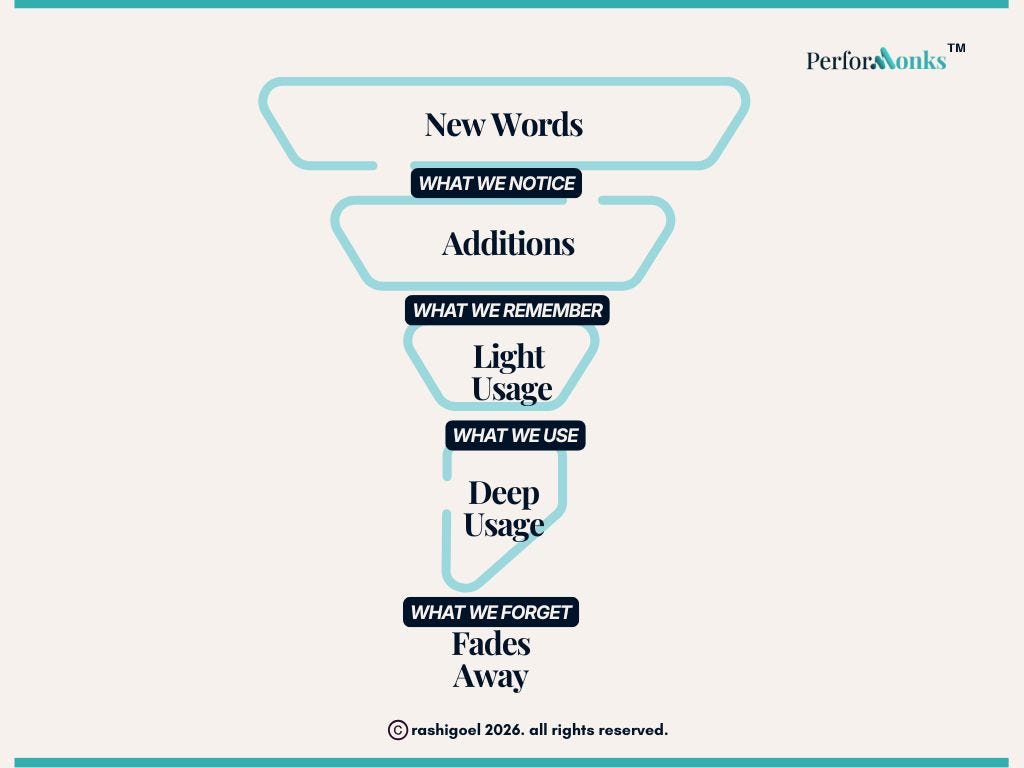
We notice what feels meaningfully different.
We remember what we noticed.
We buy what we remember.
We continue to remember as long as that meaning stays alive.
We forget as fast as meaning fades.
I have developed The Brand Absorption Matrix, a simple 2X2 matrix to help us think about how brand (and words) enter and leave our lives (and vocabulary).
The Brand Absorption Matrix
Two forces decide whether a word (or a brand), stays or fades:
- Speed of Entry: did it build up gradually or suddenly? (X-axis)
- Depth of Absorption: did it stay on the surface or did it become a part of our lives?(Y-axis)
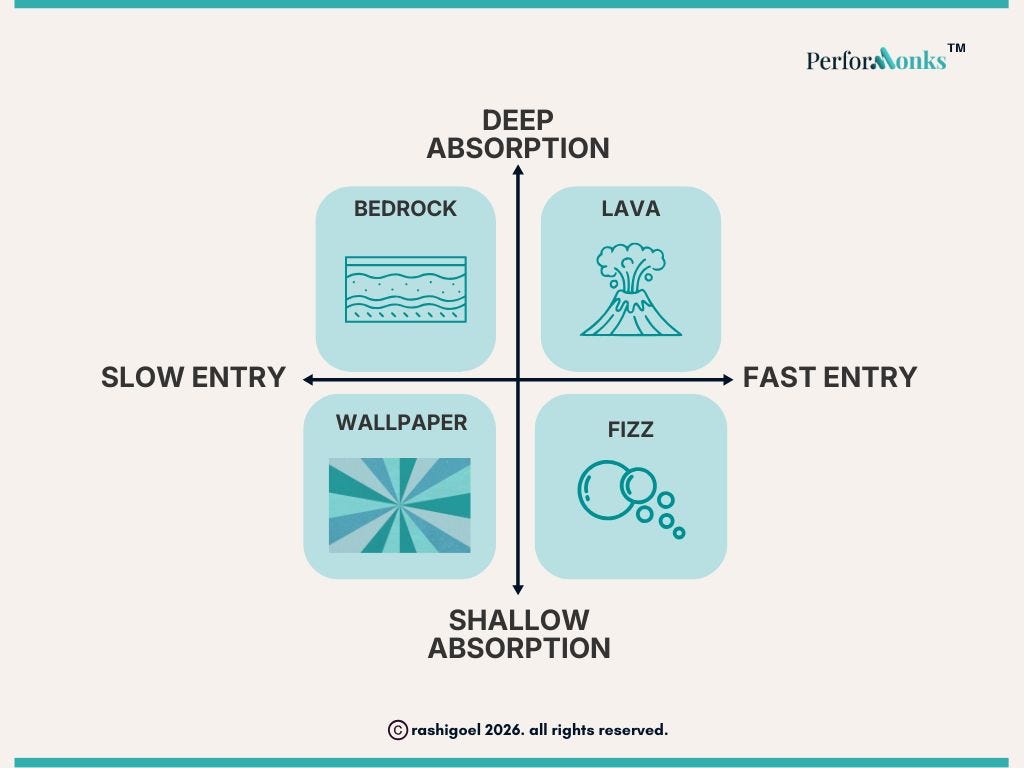
This creates four kinds of brands and gives a framework to think about how to deepen brand usage, depending on whether you are a new D2C or a legacy brand.
Bedrock
Built over decades, difficult to uproot
Amul. Parle-G. Cadbury Dairy Milk. Colgate. Coke. Maggi. Tata Salt.
Home, mother, family, love, trust, empathy, democracy, sustainability
These brands have become a part of our lives over decades, and their memories, habits and experiences are layered into our lives like sediment.
Legacy FMCG occupies this place of honour.
Trusted, familiar, safe, belonging, nostalgia. These are visceral emotions that are difficult to forget and dislodge.
The Strategy Blindness™ risk these brands run into is thinking they need to deepen meaning by repeating the past, and ‘buying’ eyeballs by upping media spends. But all they will end up with are large swathes of consumers, lulled into a coma of boredom.
Instead, they need to evolve their meaning for today’s times, because —> in today’s demand-side abundance, the consumer is changing faster than they have ever before. —> Alongside that, the competitive landscape has completely transformed since covid.
This is both a threat and an opportunity.
Sadly, having been a part of these organisations, my instinct is that they might not move at the speed of the consumers’ needs.
Lava
Forged in a flash, permanently here
Jio. iPod. Nykaa. Fogg. Pulse Candy. Id Fresh. UPI, PayTM. Lenskart. BoAt. Atomberg.
#Metoo. Selfie. Google it. Woke. Gaslighting. Epstein Class.
They enter suddenly, grab attention, and get absorbed into our lives. This is not the attention grab of a vacuous influencer, but an addition that’s meaningful because it fills a need gap or a cultural truth that needed to be said.
This is the empty space for both D2C and legacy FMCG, provided they ask, “What are the gaps still open in the market that I can fill?”
Brands that succeed in this space are rare because they need a perfect storm – an unmet need + a meaning gap + cultural readiness.
The Strategy Blindness™ risk these brands run into is that they might not have cultivated the craft to unearth these insights. Even worse, if they do come up with original ideas, they might run into a machinery of egos and misaligned incentives that might refuse to ‘see’ the insights and ideas.
Wallpaper
Layered over time, crumbles easily
For me they are Sunsilk. Fiat. Bitcoin. Clinic Plus. SBI. Lux. Bournvita. Horlicks. Traya.
Synergy, holistic, end-to-end, best-in-class, world-class, world peace
Brands that have allowed their ‘meaning battery’ to run out of charge, end up as wallpaper.
These are brands you’ve seen a thousand times but felt nothing. You recognise them, but don’t feel motivated to try them. Or you have tried them and then moved on.
These brands are to our lives like jargon is to a Strategy Blind™ presentation – hollow of meaning, borrowed, and used mindlessly.
These brands confused access and presence for magnetism. They invested in media buying, performance marketing and Blinkit promotions, but their product was average and ironically, they differentiated less over time, not more. (Because again, the category or the consumer, sometimes both, are racing ahead).
Obviously, bedrock brands run the risk of becoming wallpaper and 80% of D2C brands have already trapped themselves into this bottom left corner by copy-pasting ‘top performing SKUs on amazon’ at their friendly neighbourhood co-packer.
Ash
Explosive, scattered, disappears
For me: Cred, X (previously Twitter), Mama Earth, Maybelline, Olaplex, L’Oreal Hair Mascara, Taxi for Sure, Aliva biscuit from PepsiCo, and the 1001 athleisure brands that are retargeting me right now
Delulu, YOLO, Rizz, understood the assignment
Think ad-funded brands that seem perennially on discount and follow you all over the internet because you clicked on ‘yoga pants’ by mistake.
Fun. Memeable. Disposable.
For legacy brands, these are bets gone wrong because there wasn’t enough consumer pull. (A symptom of lack of depth in market and consumer strategy).
But D2C brands are the main occupants of this space they rent from Meta, Google and E-Commerce. They copy products, source them from co-packers (or China) and optimise their business model for a fast cash burn-fast scale up-fast burn out lifecycle.
FMCG needs to learn to evolve with the times. D2C needs to learn to mean more.
And that’s the work most brands — on both sides — have stopped doing.
TMore ways to connect
- Strategy Activator Workshops — done with you.
We have a proven approach that we tailor to your context.
At the end of the process, you will have a strategy blueprint for growth. The approach has received great feedback from Harpic, Tata Salt and Tata Sampann. Click here to share your interest and I will get back to you.
- DIY Strategy Products
I am building self-serve products you can use to develop your growth strategy. Join the early list for first access.