TL:DR: Moats are built on scarcity. When technology democratises these moats, what was once scarce becomes abundant and legacy moats start shattering.
New points of scarcity must be discovered to construct new moats.
More and more, the new scarcity will be invisible and intangible- meaning, value, and differentiation. But marketers continue to optimise only the visible – dashboards, metrics, algorithms. That’s why they believe the market is overcompeted. When in reality, the market is understrategised.
Content
- The four horsemen and covid disrupted the industrial-age playbook and created the D2C industry
- A D2C industry performance review would look like a VC portfolio bell curve
- India is not over competed. It’s under strategised.
- We’re in the age of abundance.
- In the age of abundance, new moats based on new vectors of scarcity must be erected
- Crafting moats based on intangibles is hard. It is easier to manage algorithms and tangible metrics and to keep telling ourselves they are moats
- Five questions to get strategic clarity
The four horsemen and covid disrupted the industrial-age playbook and created the D2C industry
For almost a century, the Great Indian FMCG industry™ has been running the industrial-age playbook – mass sourcing, mass production, mass logistics, mass distribution, and mass marketing through TV.
Industrial-era playbook
Supply side
Mass Sourcing (purchase raw material in bulk) → Mass Production (huge invested capacity in a factory network) → Mass Logistics (factory to warehouse to distributor to wholesaler to kirana) →
Demand side
→ Mass Last-Mile Distribution (kirana to consumer) → Mass Demand Creation (TV ads stream right into consumers’ homes)
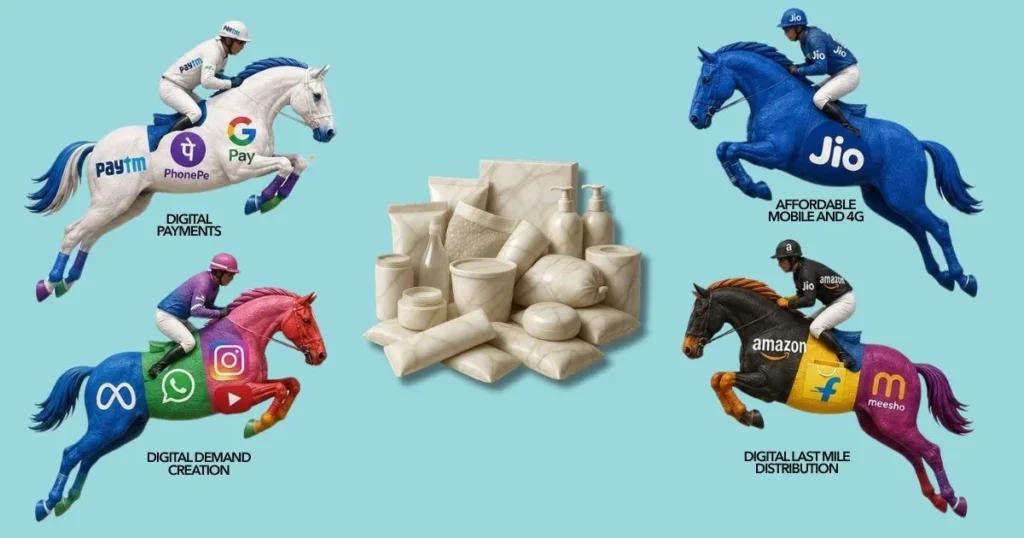
Enter the four horsemen of technology:
- Digital demand creation – social media, YouTube
- Digital mobile and 4G – Jio
- Digital distribution and last mile logistics – Flipkart, Amazon, Meesho, Big Basket
- Digital payments – PayTM, Google Pay, PhonePe, Amazon Pay
They disrupted parts of the playbook by digitising distribution, logistics, and demand creation.
Industrial-era playbook disruption phase 1
Supply-side disruption
Mass Sourcing → Mass Production → Mass Logistics (factory to e-commerce warehouses) →
Demand-side disruption
Mass Last Mile Distribution (e-commerce to consumer) → Mass Demand Creation (social media and YouTube stream content and ads onto each consumer’s screen)
This created a runway for hundreds of new D2C brands, fed by co-packers, China, and later Korea, who did not demand high MOQs (Minimum Order Quantity).
Add the pandemic to the mix and people had more time, which they spent online.
More time online meant more brand discovery.
More brand discovery meant more trials.
When more brands sold, even more brands entered.
Capitalism was in play. And where capitalism thrives, financiers and service providers follow.
VC firms opened shiny new D2C divisions.
Service startups mushroomed – R&D experts, logistics partners, performance marketers, influencers, and content agencies – to feed the boom.
Quick commerce arrived with Lord Hanuman-like urgency to deliver Sanjeevani booti within 10 minutes.
The disruption was complete.
Every. Single. Moat. Shattered.
Industrial-era playbook disruption completed
Supply side disruption
VC funding → Micro Sourcing → Small Batch Production (co-packer with in-house R&D, China, Korea) → Micro Logistics (co-packer to warehouse to e-commerce warehouses and quick commerce dark stores)
Demand side disruption
Mass Last-Mile Distribution (e-commerce and quick commerce to consumer or logistics partner to consumer) → Mass Demand Creation (social media, YouTube, influencers, content and performance marketing streaming into individual screens)
Consumers tried new brands. Some stayed, most moved on to try new brands. But D2C stayed.
A D2C industry performance review would look like a VC portfolio bell curve
→ A few breakout successes, while the rest struggle.
A few breakout successes,
Minimalist, The Man Company, Beardo, True Elements, Cosmix, Plix, and Oziva that were bought by legacy FMCG, (if acquisition counts as success, but I digress).
The Whole Truth, Mokobara, Sweet Karam, Wakefit, The Bombay Shaving Company, Sleepy Owl, Blue Tokai, (continue a steady march forward).
and a majority that struggle,
D2C brands on average, have reached 1% consumer penetration at best
68% of Indian D2C brands operate at negative unit economics – avg. CAC of ₹1,850, gross margin per order ₹607 → ₹1,243 loss on first purchase.
What’s going on?
The most common argument is that “India is over competed.”
“It is a dog-eat-dog market. Consumers don’t buy, and too many brands jostle for the same cohort. It sucks.”
That’s the wrong argument.
India is not over competed. It’s under strategised.
The context within which FMCG used to operate has changed.
It demands 3-D chess, but we continue to pay checkers.
Here’s why.
a. We’re in the age of abundance.
Digitisation has made demand-side and supply-side ecosystems frictionless. Anyone with an idea can produce, launch and sell a brand. Therefore, we are living in the age of abundance.
In the age of abundance, what was once scarce, becomes abundant.
Today, we have,
→ more D2C brands,
→ longer retail shelves,
→ more content,
→ more messages,
→ more distinctive assets,
→ more choice,
than ever before.
b. In the age of abundance, new moats based on new vectors of scarcity must be erected
When what was scarce becomes abundant, moats built on it shatter.
New moats based on new vectors of scarcity must be erected.
Old moats were capital intensive and time consuming. That’s why they were scarce. Distribution took decades, crores of money and man hours to erect. TV was capital-intensive too.
That’s why consumer reach – both mental and physical availability – was scarce. Digital commerce and social media algorithms have converted access and availability into a frictionless utility that anyone with a UPI can buy with a click.
So, we end up with,
→ more D2C brands than buying capacity,
→ longer retail shelves than browsing time,
→ more content than attention,
→ more messages then memory,
→ more distinctive assets than taste,
→ more choice than loyalty.
Capacity, time, attention, memory, taste, interest, loyalty – all intangibles. All markers of mental availability. All increasingly scarce.
All indicate that new moats will have to be built around consumer backward strategies that craft relevance, meaning, and the differentiated value a brand+product adds to consumers’ lives, and so create mental availability.
This is the timeless marketing playbook that has not been disrupted. But in a cluttered consumer mind space, needs to work much harder.
c. Crafting moats based on intangibles is hard. It is easier to manage algorithms and tangible metrics and to keep telling ourselves they are moats
Crafting moats out of intangibles (the meaningfully differentiated value that a brand+product adds to consumers’ lives) is super hard, because there are no right or wrong answers – it requires judgement, sensemaking and insight.
But most importantly, it requires time, patience, and experience.
If we want to answer, ‘what is differentiated value,’ we need to sit with a blank piece of paper and lots of questions.
Instead, ‘how do we optimise tangible metrics and algorithms’ is easier to answer. And faster. It also gives us a dopamine high when we see numbers and curves move upwards.
That’s why, we obsessively track what’s visible – algorithms, activity plans, big days, KPIs, CAC, LTV, NPS, GMV, EBITDA, discounts, dashboards, decks and docs – and become blind to invisible forces that are changing consumers’ mental availability algorithms and reshaping the market.
We have become a system that has,
→ more discounts than meaning,
→ more doers than thinkers,
→ more dashboards than understanding,
→ more decks than judgement,
→ more docs than builds,
→ more action than curiosity,
→ more fundraising than repeat purchases,
→ more investor interest than consumer TOMA.
So when a founder says “India is over-competed,” what they really mean is that everyone is fighting in the same market, renting the same distribution and media pipes to reach the same consumers with lookalike propositions.
That’s why I say the industry is under strategised, not over competed.
Five questions to get strategic clarity
The outliers (The Whole Truth, Minimalist, Mokobara, Blue Tokai) built meaning by answering 5 questions:
- who is my consumer?
- what do they value?
- what can I uniquely, uncopy-ably offer them?
- does that offer harness my unique strengths?
- how can that offer become a platform for all my commercial actions?
In a country of 1.4 billion consumers with low FMCG penetration, there’s space for everyone—provided they stop mistaking discounts, docs, decks, and dashboards for strategy.
Two ways I can help
- Strategy Activator Workshops — done with you.
We have a proven approach that we tailor to your context.
At the end of the process, you will have a strategy blueprint that answers the five questions above. The approach has received great feedback from Harpic, Tata Salt and Tata Sampann. Click here to share your interest and I will get back to you.
- DIY Strategy Products
I am building self-serve products you can use to develop your growth strategy. Join the early list for first access.
Sources and inspiration
- Alex Danco’s essays on the age of abundance
- Various articles from Ben Thompson’s Stratechery
More ways to connect
- Strategy Activator Workshops — done with you.
We have a proven approach that we tailor to your context.
At the end of the process, you will have a strategy blueprint for growth. The approach has received great feedback from Harpic, Tata Salt and Tata Sampann. Click here to share your interest and I will get back to you.
- DIY Strategy Products
I am building self-serve products you can use to develop your growth strategy. Join the early list for first access.