
I was ready to make Moxie my hair care brand. Until.
I have curly, frizzy hair, so am always in the market for the perfect curl cream.
I bought Moxie’s leave-in conditioner the minute I noticed the brand. It wasn’t an all-out wow, but didn’t disappoint either. I remained open minded and was ready to swipe right on their Finishing Stick as I prepared to make Moxie my made-in-India-curly-hair-expert.
A few months later, I noticed that they added a Scalp Reviving (read dandruff) range for wavy hair and a Damage Repairing range for straight, coloured hair.
What did I miss? Does only wavy hair get dandruff? If I color my curly hair, does Moxie not repair the damage? Is color damage somehow different on straight hair?
Clearly, Moxie had shoe horned new propositions into a brand conceptualised for curly hair. To grow revenue faster, and with it, valuation.
And just like that, Moxie had slipped itself out of its spiky position in my head while the cement was still wet.
It was now just another D2C in a hurry to get big.
D2C’s stay spiky or broaden paradox
Digital has expanded brand choice well beyond what the human brain can comprehend. As a result, overwhelmed consumers shrink their brand decisions into a binary –
→ either the familiar, safe, and trusted (like Pantene),
→ or the differentiated spike that solves their exact problem (like Moxie for curly hair).
The undifferentiated middle dies.
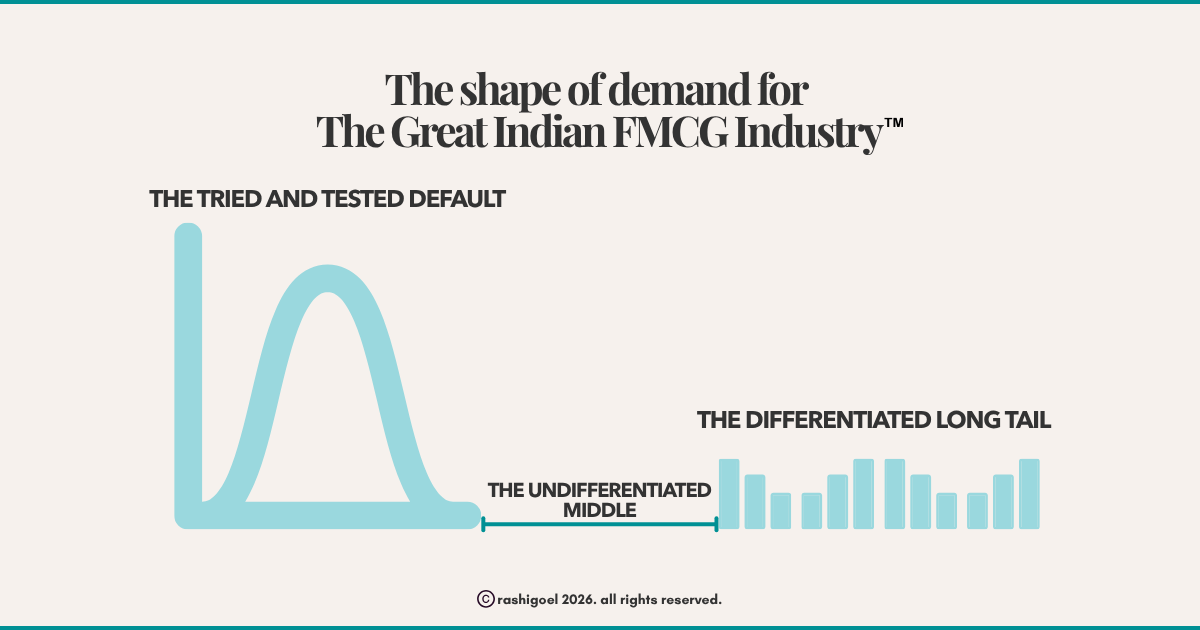
D2C brands enter on the right-hand side of this curve, on spiky propositions. And almost immediately, they start teetering on the edge.
→ On the one hand, the spike looks too small to support a big business, so they broaden.
→ On the other hand, they broaden too much and fall into the undifferentiated middle, only to be forgotten forever.
Most people ask, how to grow when your spike makes your TAM small?
I think TAM is not the issue here. In a country the size of India, if chosen well, a spike rarely has a TAM problem.
Quick math shows that curly hair TAM is large:
→ Top 20% of India ≈ 267 million people.
→ Assume ~49% are women, and ~1/3 have curly hair → ~44 million curly-haired women.
→ Assume younger women adopt the curly-girl routine and only half are under 40 years → ~22 million curly-haired women.
The real question is, why do most investors only see the math that’s visible?
Because the math they overlook becomes their blind spot and pushes them into the undifferentiated middle.
First, the math they see
Current conversion is (only) 0.9% in two years:
Moxie reported Rs.100 crore ARR in December 2025. At an average MRP of Rs.5001, they managed to get roughly 2 lakh women to buy them once. That’s 0.9% penetration of a 22 million TAM.
The spread sheet says broaden
With ‘only’ a 0.9% penetration in 2 years, target revenue is still far away. Add wavy. Add straight. Add coloured. Add dandruff.
(In short, broaden and die).
The math that’s a blind spot
The spike has barely been scratched. I would even say that for a two-year old brand, a Rs.100 crore ARR is impressive.
But just doubling down on curly hair, if they reach 20% of the TAM at the current avg. Rs.500 price, they get to an ARR of Rs.220 crore. At Minimalist’s 10X exit multiple (HUL paid Rs.2,955 crore for 90.5% at Rs.350 crore revenue), that’s a ~Rs.2,200 crore valuation without ever broadening beyond curly hair.
Blind spot one: we think we can convert the other 4.2 million2 through product features alone
We get so focussed on valuation that we stop thinking consumer backward and overlook the intangibles that actually get people to buy.
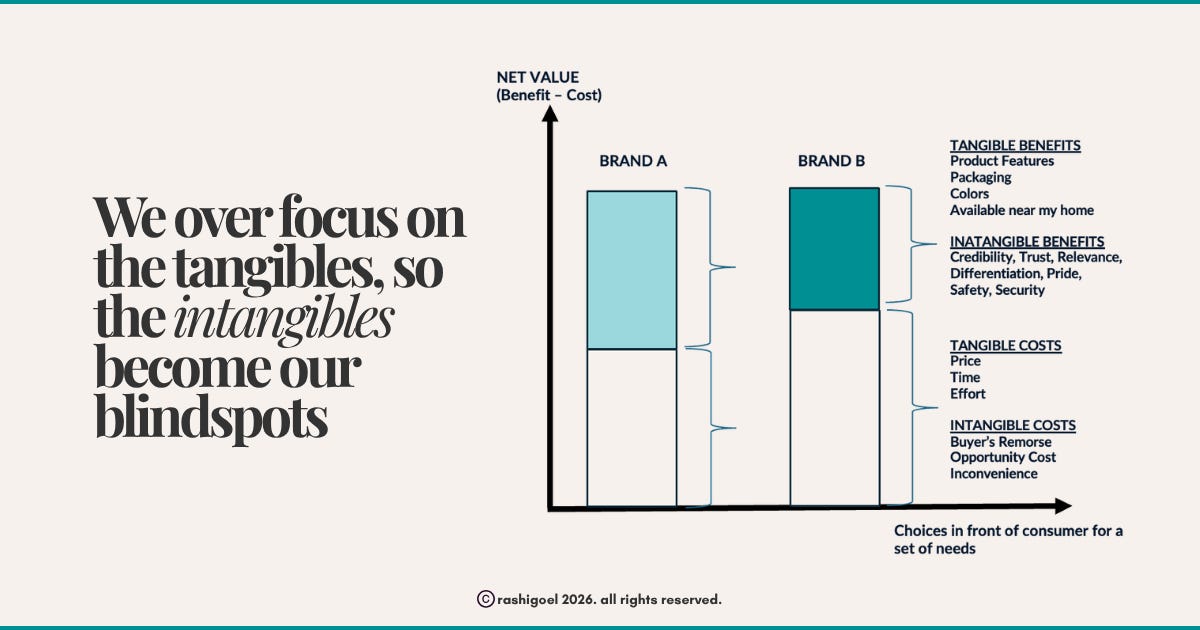
Any curl care product checks the visible boxes.
Curls hair. Controls frizz. Smells great. Offers a discount. Cute founder brand.
But a curly girl repeats, recommends, and advocates because of the intangibles.
Identity. Belonging. Desire. The feeling that this brand is for me, made by people who get it, and using it makes me more of who I’ve always wanted to be.
When we ask ourselves →how can I get 4.2 million curly girlies to buy again, and also tell their friends,
instead of → how do we get bigger faster,
we start deepening the reason why they bought in the first place → this is exactly what I need.
Blind spot two: intangibles don’t show up on a P&L line, but they surely impact it.
Broadening gives immediate visible gains – growth spike, more SKUs, more shelf-facings, more revenue line items.
The cost of staying narrow is invisible. Which is why D2C brands blunt the spike that got them success in the first place when they go with the spreadsheet that only sees the numbers.
To deepen the ‘this is exactly what I need’ feeling, launch the adjacent possible
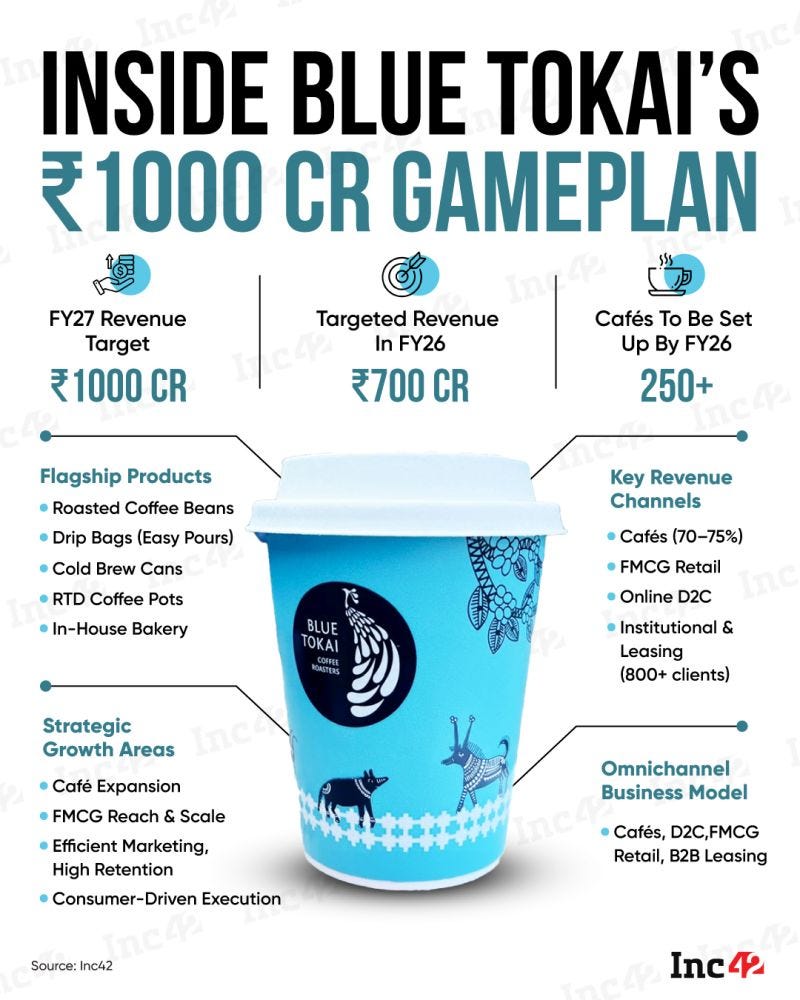
Blue Tokai understood the India 1 cohort that had experienced coffee globally, but missed it back home.
They had their spike – specialty Indian single-origin coffee experiences. They then deepened it by systematically moving one adjacent step at a time3.
→ Good beans → next adjacent format- Drip Bags, Cold Brew, RTD.
→ Because people now owned good beans at home, coffee home equipment became the natural next step.
→ Because they were grinding at home, they wanted a café experience to match. So Blue Tokai cafés became the natural next step.
→ Because cafés existed, a bakery collab with Suchali’s became the natural next step.
→ Because a loyal consumer base formed, subscriptions became the natural next step.
Notice what Blue Tokai did not do. It didn’t define the adjacent possible as the next bigger TAM beverage category – chai, or instant coffee, or energy drinks.
The adjacent possible is the next thing your consumer needs to solve their exact problem.
People hear “adjacent possible” and think, the next product category.
Dandruff, coloured hair, straight hair, all next to curly.
For Moxie, the curl expert for Indian hair, adjacent means everything the curly girls needs to solver her curly hair problem. Each addition will deepen the spike instead of diluting it.
Before any expansion, a D2C founder should ask only one question:
Does this sharpen my spike, or does it broaden my operations?
The spreadsheet will always push you to broaden. If you double down on serving ‘this is exactly what I need’, you build a stronger moat4, and grow faster.
1Moxie’s website – SKUs range from Rs.489 to Rs.2295 (combos)
220% of 22 million is 4.4 million. at 0.9% penetration, Moxie has reached 0.2 million. Balance – 4.2 million
3Stuart Kauffman, a biologist, gave us the theory of adjacent possible – systems don’t grow randomly, but through systematic steps that follow the previous step → each move you make creates a set of moves you make next.
4When you deepen your spike, you build a moat against other D2C bros who, the moment they see you do well, will copy your playbook.
Two ways to stay in touch
- Strategy Activator Workshops — done with you.
A proven approach that we tailor to your context. At the end of the process you will know the spike you can double down on. The approach has received great feedback from Harpic, Tata Salt and Tata Sampann. Click here to share your interest and I will get back to you.
- DIY Strategy Products
I am building self-serve products you can use to develop your growth strategy. Join the early list for first access.