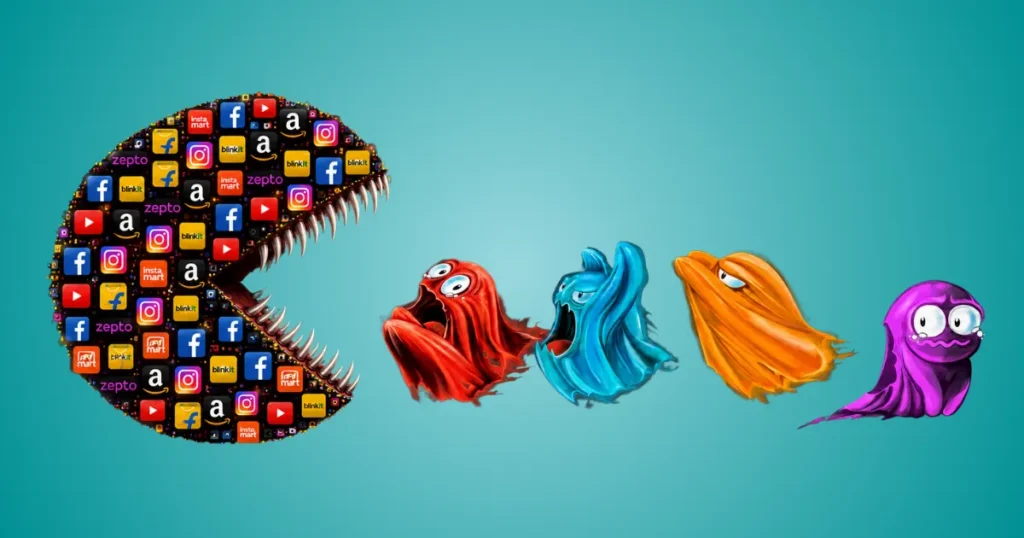
TL;DR: Whoever owns the scarce bottleneck captures value. In Rockefeller’s time, the bottleneck was transportation. Today, for FMCG brands, the bottleneck is attention. That’s why platforms are charging ‘toll’ and squeezing margins. But if you keep renting that bottleneck, you are not building a business.
There was a time when transportation was more precious than oil
By 1871, America had plenty of oil refiners. What it did not have enough of was railroad capacity. Railroads spotted this opportunity started price wars to grab market share.
To end this race to the bottom, big refiners decided to collude with railroad owners. They even built a company for this – The South Improvement Company – and issued shares to cartel members.
In a move that would make even Trump grifters blush, they gave huge concessions to big refineries while squeezing small ones:
- small refiners paid $2.56 to ship a barrel
- cartel members only paid $1.50. AND they got $1.06 for each barrel small refineries shipped
- that’s not all. Railroads even shared competitors’ shipping details with cartel members!
So a small refiner was not just paying more to reach the market, they were also funding the people trying to kill them.
Refining was a scale business – costs reduced exponentially with scale (a plant with double the output is only 50% more expensive to build1). Which means big refineries were already doing better than small ones even before the cartel.
So when the news of the collusion leaked in 1872, small refiners panicked and, to avoid financial ruin, sold to J.D.Rockefeller2, who was already buying smaller refineries to add scale to his business.
This was the famous Cleveland massacre, which consolidated The Standard Oil Company into the world’s first monopoly.
The lesson is that real money lies in what’s scarce
Carlotta Perez reminds us that all techno-economic revolutions follow this pattern.
A new technology creates a new market. → Railroads were the new technology then. Digital platforms are the new technology now.
What used to be scarce becomes abundant. And something else becomes scarce. → Oil was becoming abundant and transportation was scarce. Today, FMCG products have become abundant. But attention has become scarce and is controlled by platforms that are just a swipe away on a billion Indians’ phones.
The owner of scarce bottlenecks start charging toll and becomes monopolistic → Rockefeller did this in the 1800s. Platforms are doing it now.
This continues until socio-political governance balances the playing field → In America, The Sherman Antitrust Act (1890) made cartels illegal, and in 1911, Standard Oil was broken up.
In the time of Rockefeller, justice came. But slowly.
By then, many small refiners had disappeared.
155 years later, attention is more precious than FMCG products
Meta, Amazon, Alphabet, Flipkart, Blinkit, Zepto, Big Basket, and Instamart have become to FMCG distribution, what railroads were to oil refiners (and as the Strait of Hormuz is to oil). And they are squeezing FMCG businesses for all they’ve got.
I say this because of this quote in Rajarshi Bashyas’ newsletter3 → ‘The cost of a keyword for something like shampoo can be more expensive than the shampoo itself’.
His argument is that FMCG margins are now structurally capped by platforms. Even the best run Indian D2C brands average only ~2–5% EBITDA, because as much as 33% to 43% of net revenue goes to platforms as fees and commissions:
- Listing: “Listing fees run into the tens of thousands of rupees per SKU per state.”
- Visibility: “The category-search slot at the top of the homepage is auctioned, exactly the way Google AdWords slots are.”
- The upside (CAC ROI) is capped: “CAC is rising 10–20% YoY on Meta and Google because ad inventory is limited. Yet, LTV is roughly flat because Indian consumers don’t repeat-buy at the rates American or Chinese consumers do. Indian D2C, on average, operates at 1.5–2.5x to CAC.”
This is the modern version of the railroad problem. If transportation was the bottleneck then, attention is the bottleneck now.
Morals alone do not feed families, nor do they pay employees
Selling to Rockefeller was an act of survival. They had no idea that the cartel would be dissolved before it had shipped even one barrel of oil.
Small refiners that went bankrupt won a moral victory when Rockefeller’s empire was broken up. But the uncomfortable truth is that they also made more money through Standard Oil shares than they would have through their own sub-scale businesses.
Selling out was a rational response to a system rigged against them.
That’s why selling to a legacy FMCG can be a strategic move. But not all brands can be a Minimalist or a Forest Essentials.
Legacy giants won’t buy a business that rents demand
The survival rate for d2C brands is incredibly low.
If 600 D2C brands have launched since 20164, Bain’s Insurgent Brand report covers 243 of them. The report shows that only 1% of these have crossed Rs.100 crore revenue. And only 22% of these have crossed Rs. 500 crore.
Only a handful of those have been bought by Legacy FMCG giants.
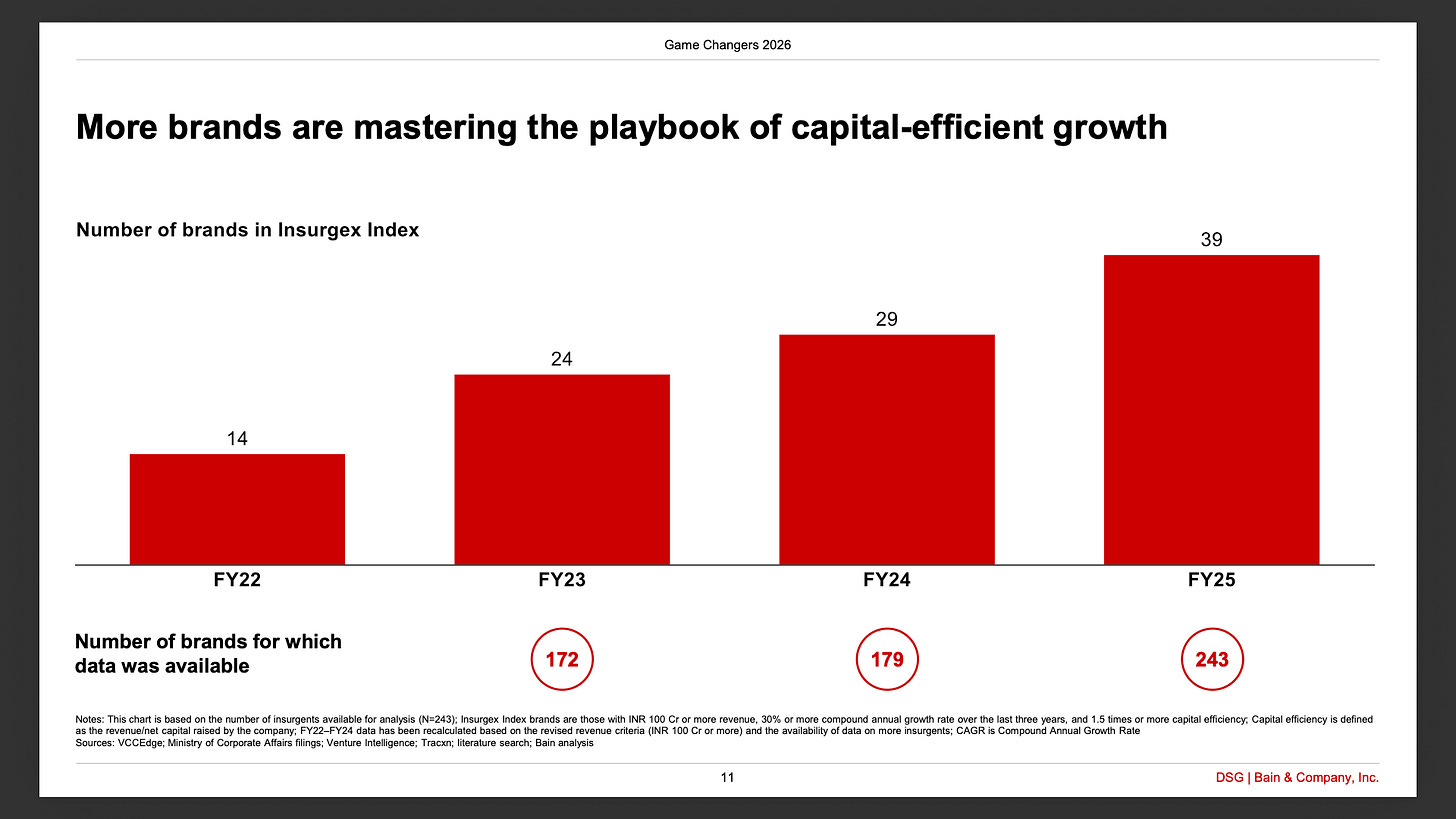
Building a D2C business only with the intention of selling it makes us strategy blind™
When our only goal is to sell out, we are tempted to rent demand instead of building it.
Renting demand gives visible results immediately. But it also makes us lazy and keeps our thinking at surface level.
We don’t have the patience to find a niche that big brands don’t play in, because a large TAM looks impressive in a pitch deck.
We stop improving our product until people repeat-buy without discounts, because revenue spikes during big days looks like proof of demand.
We don’t wait to win one channel before entering others, because wide distribution looks like scale.
But if you want a legacy company to buy you, only one question matters.
Does demand drop the minute you stop paying toll to the platforms? If it does. You’re not building a business, you’re renting it.
1 How Rockefeller and his partners built standard oil
2 There are contradictory accounts on whether Rockefeller initiated the cartel or not. But he was certainly a cartel member.
4 https://economictimes.indiatimes.com/industry/cons-products/fmcg/why-is-small-so-big-for-indian-consumer-companies/articleshow/117485672.cms?from=mdr