
As I work more with clients and think more about the strategy process, I realise that at its simplest, strategy is a three-step process – extraction, transmission and execution, with intent underlying all of it.
It’s like you’re passing the baton while playing three-dimensional chess. You not only run into multiple failure modes in strategy development, but also while passing the baton.
In total, I have seen strategy fail in six ways.
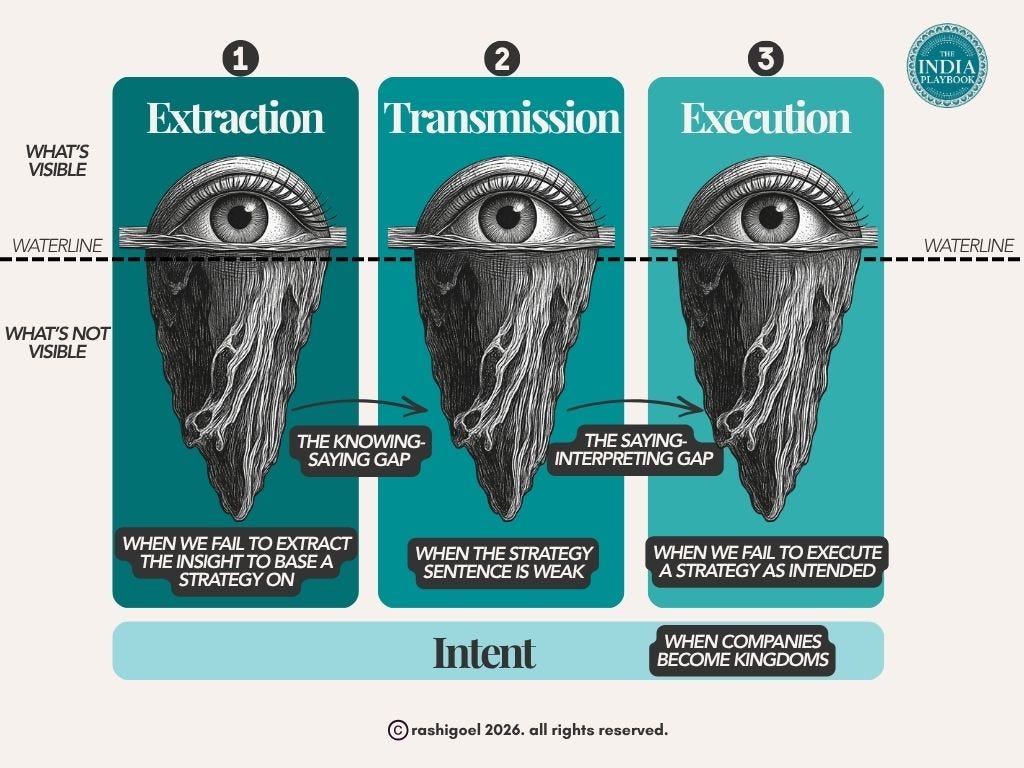
1. Extraction failure – when we fail to extract the right insight from which to build a strategy. (My Strategy Activator™ Workshops start here).
2. Extraction to Transmission failure – when we have a great strategy, but we can’t translate it into a strategy sentence that captures its essence. I call it The knowing-saying gap.
3. Transmission failure – the strategy does not travel to every nook and cranny of the company.
4. Transmission to Execution failure – when the strategy is not interpreted the same way by different functions, departments and people. I call this The saying-interpreting gap
5. Execution failure– when everyone interprets a strategy in their own way, the strategy does not get executed as it was intended. We all know that a choppy, misaligned execution is doomed to failure.
6. Intent failure – when a company’s culture and incentives create conditions of strategy blindness™. I have written about it here → When companies become kingdoms, they go strategy blind™.
Today, I write about the knowing-doing gap – why simply knowing your strategy isn’t enough; you have to say it in a Strategy Goldilocks Sentence.
We need a sentence because we only know what we think, through words.
In one of our Strategy Activator™ Workshops, we identified an insight and captured it in an ‘aha’ sentence.
We thought our client would be pleased.
Instead, she felt we had not delivered a ‘breakthrough’ insight because she had known ‘it’ all along, and just had not been able to find the words to say ‘it’.
I don’t blame her because the strategy sentence we wrote made our client’s tacit knowledge visible. When we see our tacit knowledge in front of us, in black and white, it starts to feels obvious.
That’s why she did not feel the ‘aha’ we felt.
But this is precisely the trap most operators fall into. Knowing it in your bones is not enough. You’ve got to say your strategy in a sentence.
(Maybe two sentences. At best.)
The Strategy Sentence is strategy development
Leaders believe that the most difficult part of their work ends when they’ve cracked the strategy.
They think ‘wordsmithing’ their strategy is fancy-schmancy work reserved for artistic types.
I say that writing the strategy sentence is strategy development, because like I said before, we don’t know what we think unless we put our thoughts into words!
Woodruff, Coca Cola’S President could have easily said, “I want you to distribute a Coke in every shop you see in every neighbourhood”. Why did he spend the time to come up with, “Cola-Cola should always be within arm’s reach of desire”?
Why did Steve Jobs tell his product team to make “iPhone icons so beautiful that you’ll want to lick them?” instead of saying, “our icons should be glossy, transparent and wobble when you touch them”?
Once you have a strategy, you have to be like pearl drivers, diving 150 feet to look for the exact words to use in your strategy sentence.
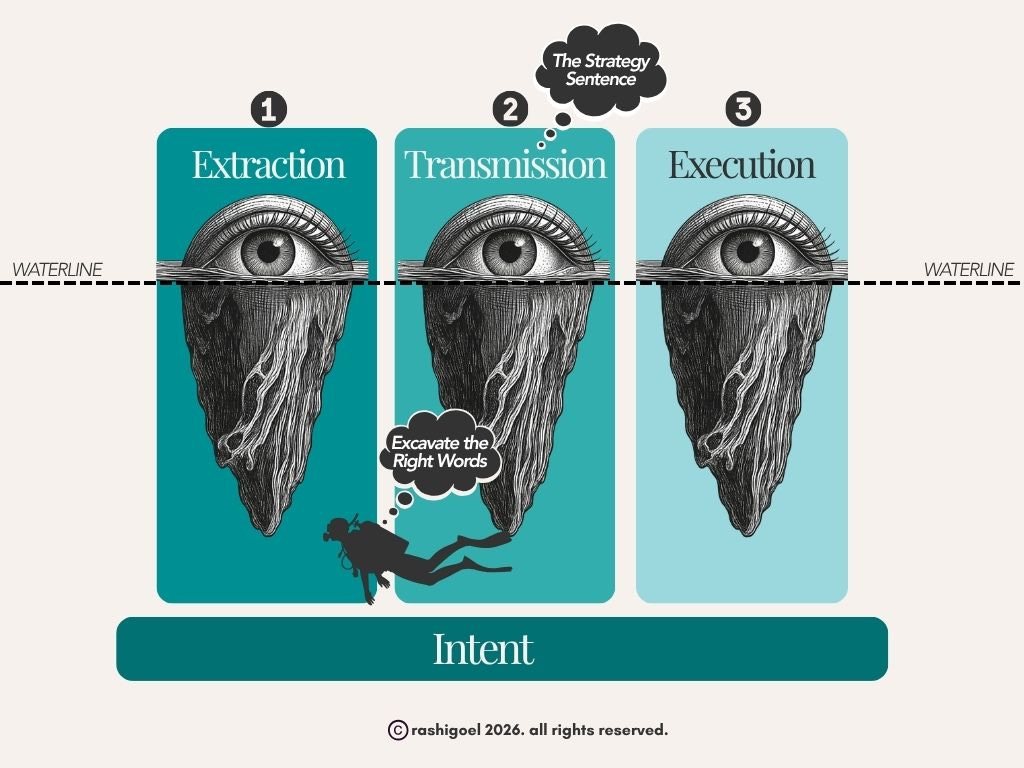
As you find, reject, and fit words into a sentence, you’ll know what you were thinking all along, and your strategy will form right in front of your eyes.
When it comes to writing a Strategy Sentence, operators trap themselves at two extremes
At one extreme, they think fancy, clever words = strategy.
Delivering a fancy deck, dressed in your Brooks Brothers suit, might fool some people. It might even fool all of the people. But it won’t grow your business.
Most good companies have strategy frameworks. Brand Key is one such framework that we used in Hindustan Unilever.
When the strategy was clear, the Brand Key was a useful tool that nudged us to be specific.
But when the strategy was unclear, we spent our time debating ‘trust’ vs. ‘confidence,’ then at 5PM, exhausted, wrote “trusted confidant” and move onto the next box.
So, beware, fancy words might be hiding the fact that there is no strategy.
At the other extreme, they think just having a strategy is enough, so they use lazy, generic words.
Strategies that ‘delight consumers’, ‘be digitally focussed’, or ‘grow profitably’ say nothing at all. No one wants to be unprofitable, ignore digital or upset their consumers.
Such words don’t clarify strategy for anyone. With the result that their strategy remains their best kept secret, while life goes on as usual.
So what is a ‘just right’ strategy sentence?
The Goldilocks Sentence – unambiguous (see), meaningful (feel), and absorbent (get)
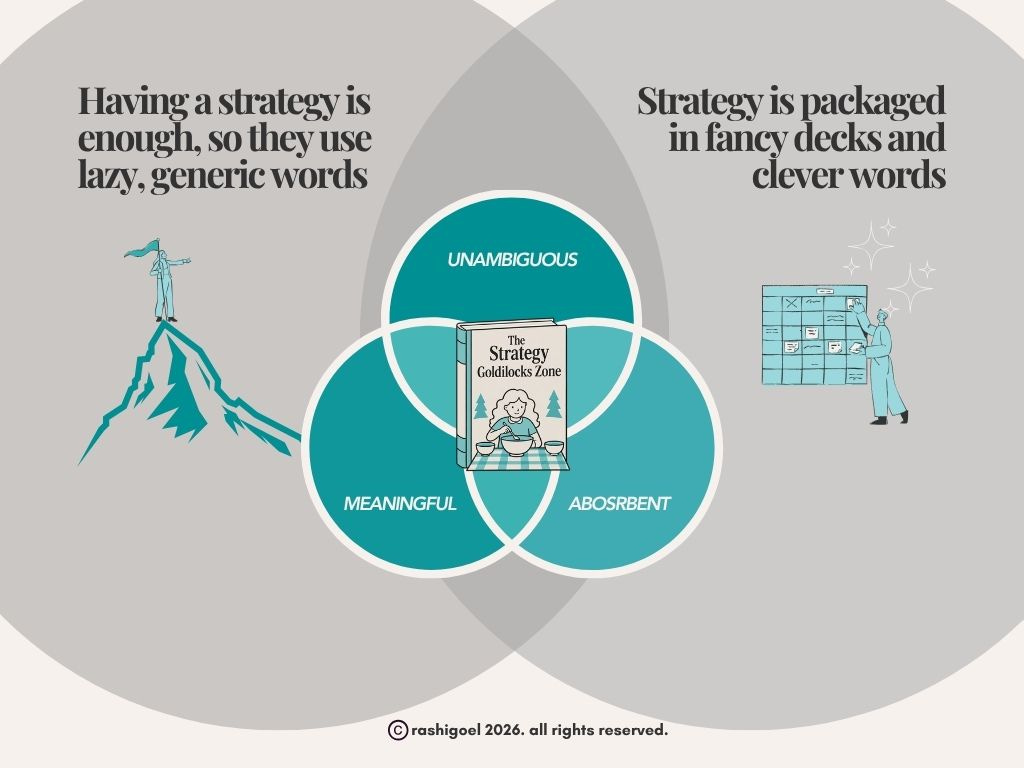
A powerful strategy sentence describes how you see the situation, how you will win, and why this choice is the best for your unique strengths.
A Goldilocks sentence is one that allows your teams to also ‘see’ and ‘feel’ what’s tacit to you, so that they instinctively ‘get it’.
Let me repeat. Only when they see, feel, and get ‘it’, will they execute your strategy the way you intended.
Unambiguous – they ‘see’ things the way you see them
An unambiguous sentence speaks to the mind. It is not open to interpretation.
No CEO operates the cash till, makes that sales call in Gorakhpur or negotiates that Diwali deal with DMart. Thousands of people who will execute your strategy, were not part of your strategy process.
So, unless your strategy sentence becomes the invisible hand that gets two different people to take the same decision each time, your strategy will fail and you won’t even know why.
Meaningful – they ‘feel’ what you feel
The sentence tugs at the heart. It motivates and inspires. Strategy is future facing, and more than telling you what you will achieve, it tells you who you’ll become along the way.
ESOPs, compensation and a fancy designation might get people in, but won’t get them to stay. After a point, they won’t even be motivating enough.
A strategy sentence gives meaning to teams and keeps them committed when things get rough. And things do get rough. So, unless your people personally identify with what they will achieve and who they will become in this quest, in this hero’s journey, they will not stay.
Absorbent – they ‘get it’, it enters their bones and their gut
You don’t want mechanical compliance. You want teams to embody your strategy, to absorb the tacit knowledge you already have, so they do what’s right even when you’re not in the room.
A small but might example of this is that Maggi brand managers and copy writers instinctively know that ad copy for Maggi, should say, “aapki Maggi mein hai”, instead of “hum Maggi main daalte hain.”
A strategy sentence alone does not guarantee success, but my goodness it helps!
Don’t you know that a man being rich is like a girl being pretty? You wouldn’t marry a girl just because she’s pretty, but my goodness, doesn’t it help?
Gentlemen Prefer Blondes
A great strategy sentence cannot rescue you from a bad strategy.
Like this Nike1 one, which ignored all the root strengths of the business.
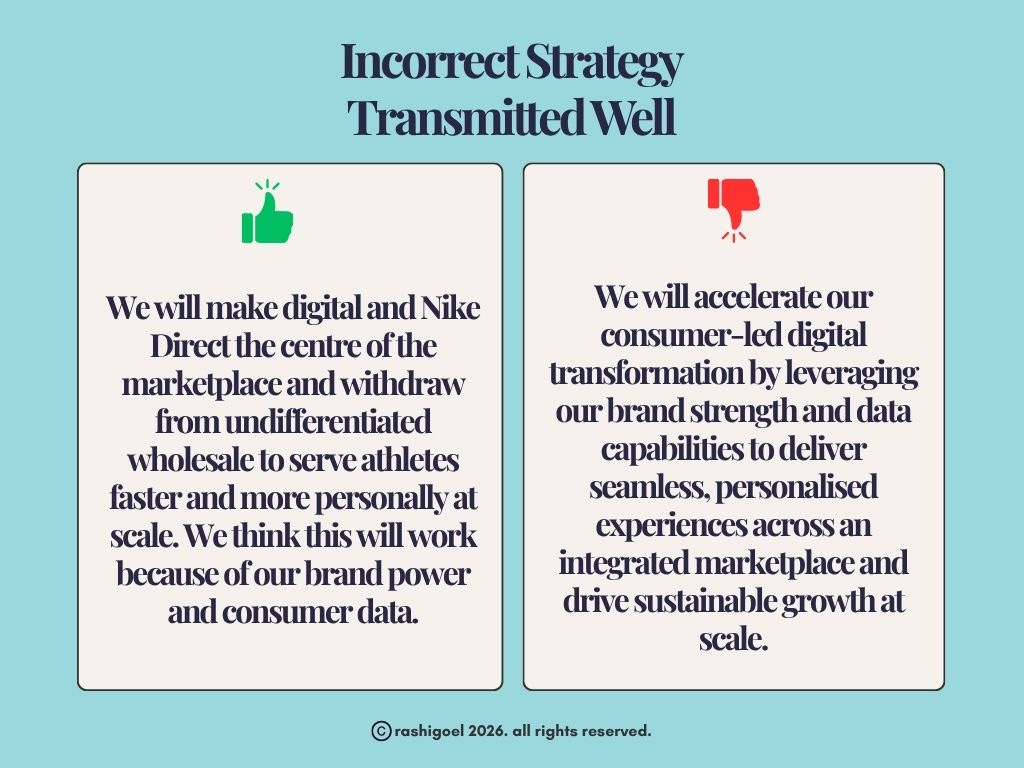
This is the equivalent of Hindustan Unilever exiting all 6.3 million offline shops and opting to only sell online. Because ‘we have brand power’. What a disaster that will be!
On the other hand, would Amul had been Amul if it had resorted to lazy MBA jargon to share its strategy? No one would have known what to do!
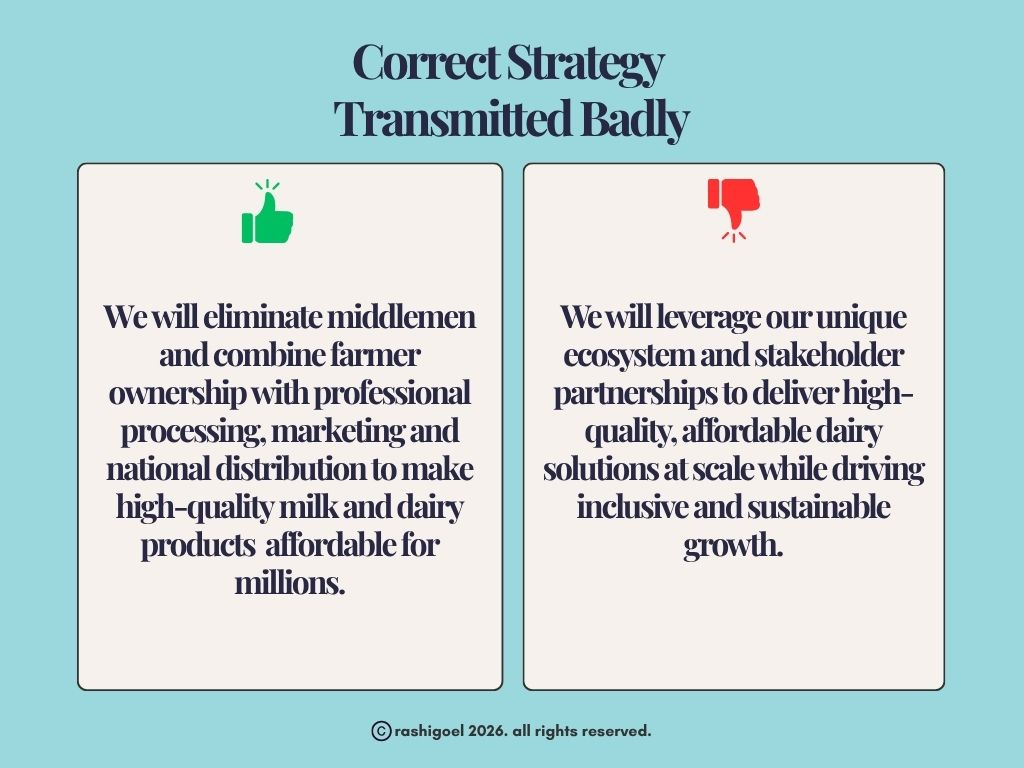
A strategy that only lives in your head doesn’t really exist.
A strategy that only lives on your deck is dead on arrival.
But a great strategy sentence can 10X the odds of you winning.