TL;DR: When technology shatters old moats, new moats must be built. Lab grown diamonds have dulled the sparkle of De Beers’ moat. in the 1880s, Japan’s Quartz technology disrupted the Swiss Watchmaking industry. But instead of sending them to their grave, it became an opportunity to forge value in two opposite directions. The diamond industry can learn from them.
History is full of stories of technology-led disruption and its survivors. That’s where the lessons for The Great Indian FMCG™ industry are.
Lab grown diamond technology has disrupted the fundamental structure of the diamond industry. Costs have plummeted and the artificial-scarcity induced moat that De Beers have painstakingly built over the last 79 years, that ‘diamonds are scarce and rare’ has been punctured.
With the result, that the De Beers business has lost its sparkle.
De Beers, the company that built the modern diamond market, has been written down by $6.8 billion over three years by parent Anglo American, posted a $511 million EBITDA loss in 2025, and closed its lab grown brand Lightbox. Anglo is trying to sell or spin off the business, targeted for the first half of 2026. The cause is structural: lab grown diamonds, optically identical and 80 to 90 percent cheaper, now make up more than 45 percent of US engagement rings.
De Beers did what all legacy companies do when their core business is threatened.
First, went into denial mode.
De Beers ignored lab grown diamonds. Dismissed them as a fad that posed zero threat to their core business.
Two, defence. They launch campaigns to prove their stuff is better than the new stuff.
As De Beers continued to deny the existence of lab grown diamonds, the Diamond Producers Association hired a new marketing director who came up with a new campaign to market natural diamonds to millennials.
Since product superiority cannot be proven, such campaigns tend to rely on highly emotional messages to prove that they are much much much better.
See the campaigns here, the India ones here and here.
Three, damned if you do, damned if you don’t.
De Beers woke up, and in a move Clayton Christensen’s Innovator’s Dilemma predicted, launched a defensive playbook.
- They created a new ‘affordable’ fashion jewellery segment below their expensive natural diamond brands. Enter Lightbox, “If you want fashion jewellery, Lightbox is your choice. If you want precious fine jewellery, then Forevermark and De Beers Jewellers is for you.”
- You could tell that their heart just wasn’t in it. Lightbox’s positioning was designed more to ‘protect’ their legacy, higher value business and less to build a real business through deep consumer understanding. You can find the Lightbox “moments not milestones” campaign here.
- Since they wanted to protect their core business, Lightbox had all jewellery, expect engagement rings.
- They priced each Lightbox diamond at a flat $800 for one-carat, hoping to undercut competitors and make lab grown diamonds look ‘cheap’.
This backfired on two fronts.
One, China flooded the market with lab grown diamonds. Prices crashed and De Beers had to drop Lightbox’s prices, from $800 to $500.
Two, just because De Beers’ Lightbox did not have lab grown engagement rings, did not mean the need doesn’t exist. Almost overnight, 50% of all engagement rings in the US were made from Lab grown diamonds. And Lightbox was absent.
Lightbox failed, and De Beers lost trust, because consumers felt that they had been overcharging them the entire time.
Even the market understood that their hidden agenda had been to show lab grown diamonds in poor light all along.
It has, overnight, legitimised a business whose legitimacy it had been fighting tooth and nail against, for decades. This is a level of arrogance only De Beers can display – and can also get away with. One cannot help but admire them.
This is not new.
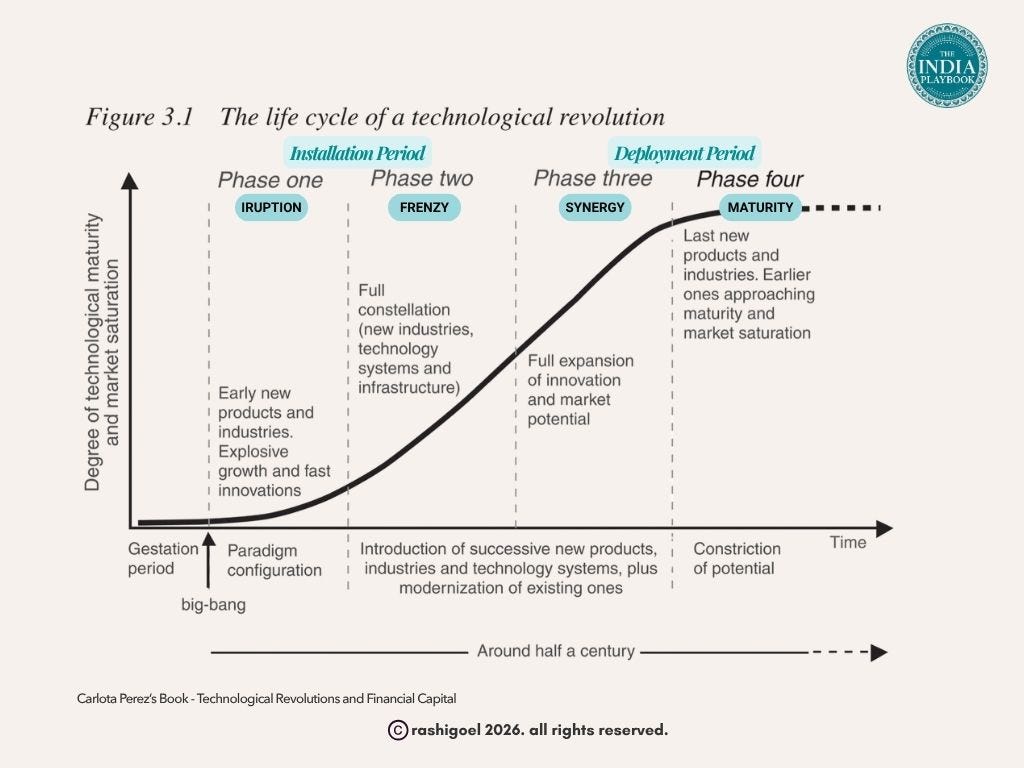
This happens in the Irruption phase of Carlotta Perez’s techno-economic revolutions thesis – when each wave of new technology commoditises yesterday’s differentiator. This changes where value sits.
When hardware became a commodity, value moved to software.
When YouTube became a commodity, value moved to content.
Lab grown technology has made diamonds into a commodity, where does the new value sit?
The diamond industry could learn from The Swiss watch industry.
In 1870, Swiss watches were known for advanced technology and craftsmanship, and produced more than two thirds of the world’s watch output. By 1945, the Swiss had over 80 percent of the global watch market.
By the 1970s, Seiko perfected the Quartz technology, which didn’t just make a better, thinner, more accurate watch, but it was also priced at just 2-3% of a Swiss watch!
Fully knowing that the only way to accelerate the impact of this new technology, Seiko licensed its patents to other companies. This led to Japanese watches like Citizen and Casio, flooding the global market, and checkmated the Swiss industry.
By 1977, Seiko had become the world’s largest watch company by revenue, and by 1980, Japan had overtaken Switzerland as the world’s largest watch producer. Between 1974 and 1983, Swiss watch production plunged from 96 million units to 45 million, while employment collapsed – from 89,000 in 1970 to just 33,000 by 1985.
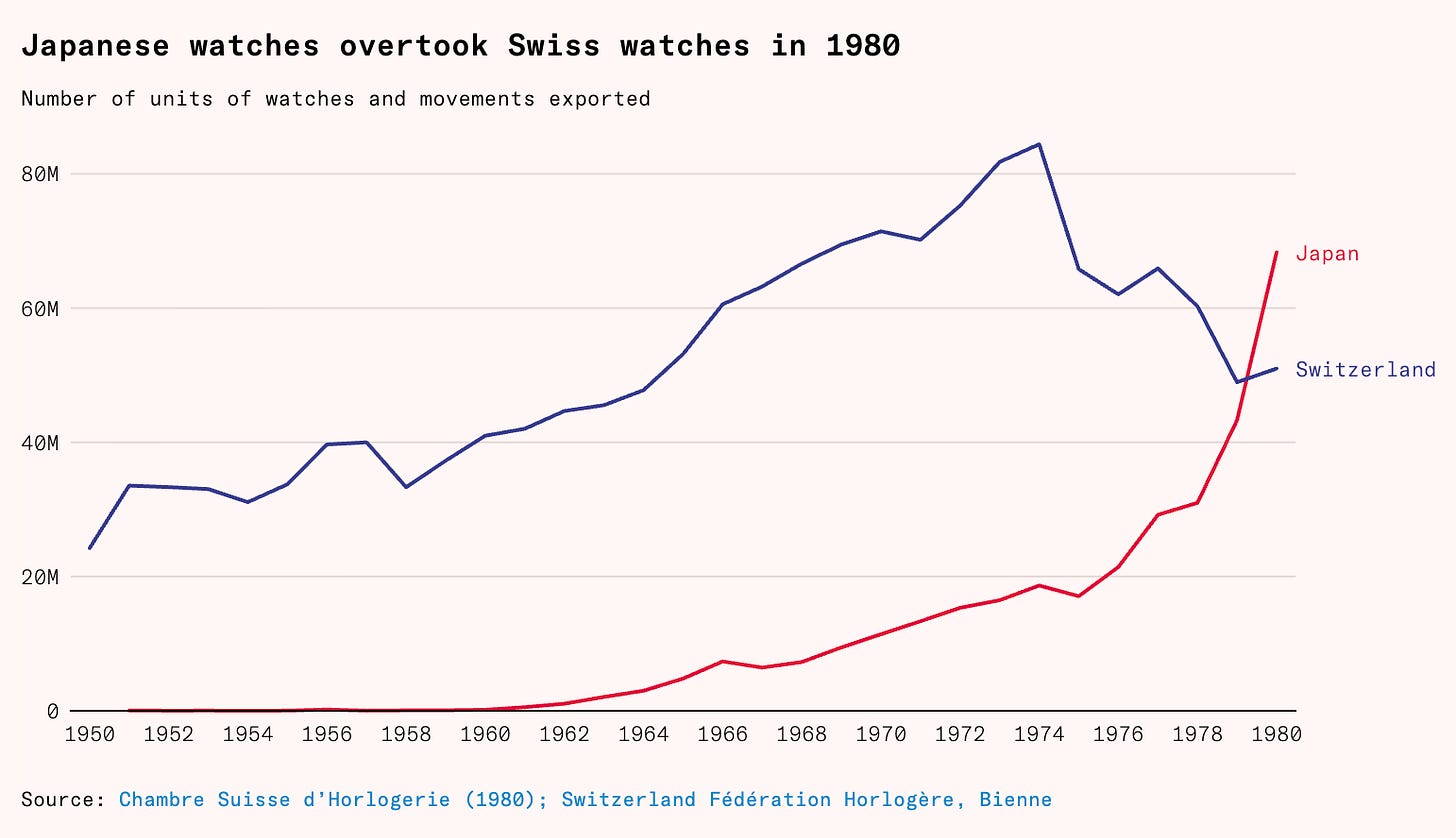
One would bet good money that the Swiss watch industry was cooked. Instead, they came back from the dead within just 20 years. So much so that even today, even though only 2% of all watches are Swiss-made, they are ~45% of value.
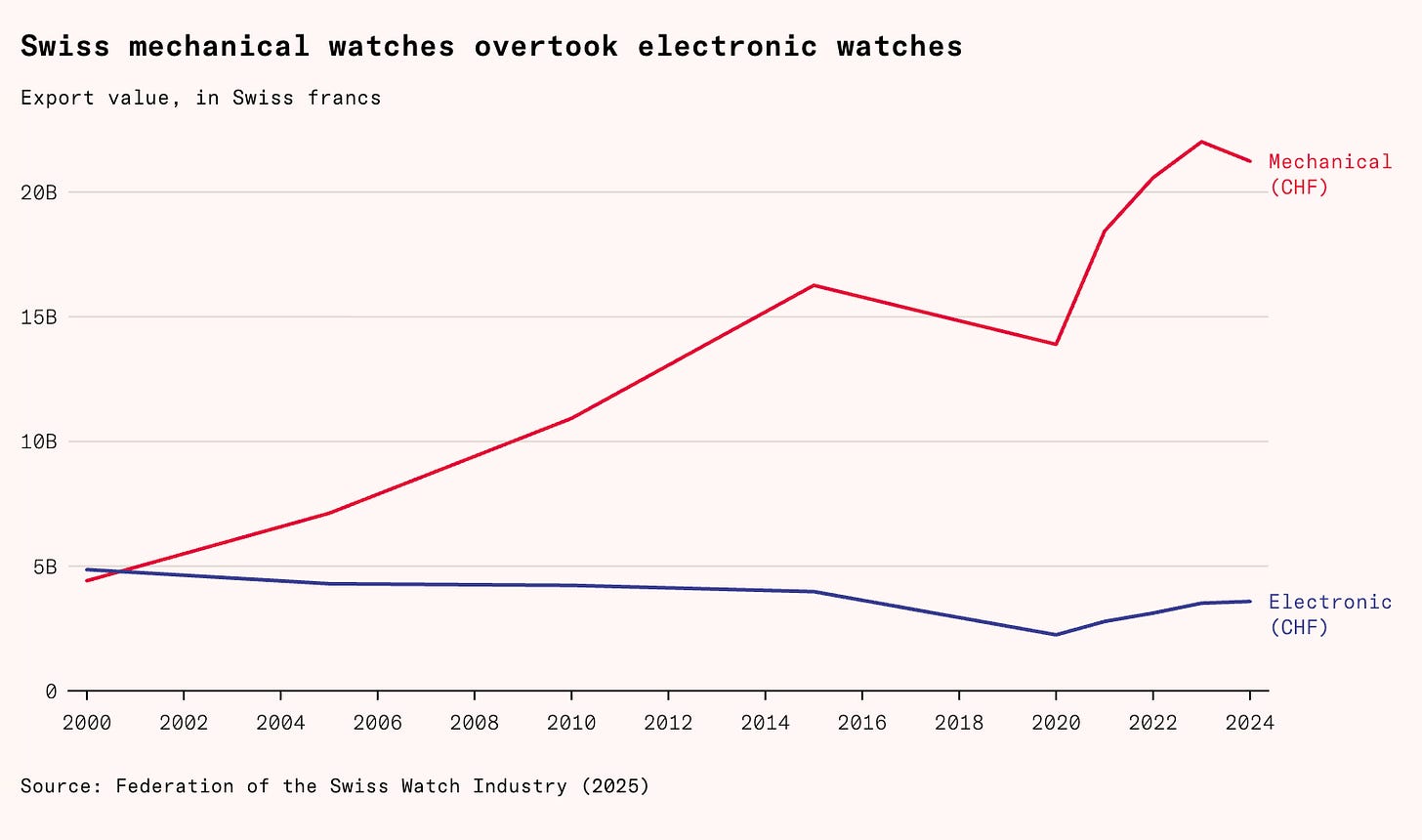
How did they do this? They deployed two different strategies.
The Jean Claude Biver move – double down on your legacy strengths.
Jean Claude Biver bought the distressed Blancpain brand from Omega. (Omega had been unable to withstand the Quartz onslaught).
His belief was that people buy watches more as statements about who they are, and less as time-keeping tools. So he decide to build the ultimate in handmade, human, and artisanal watches.
In a move that celebrated the human touch over machines, Biver turned the precision of quartz against itself and said, ‘That famous quartz precision became of secondary importance. Who cares about ultra-precision to a quarter of a second in everyday life? As a famous Italian retailer explained to his customers: you’re a lord, and a lord doesn’t need the exact time!’
The result: Blancpain grew from CHF 9Mn in 1985 to CHF 56Mn by 1991. More companies, Rolex and Patek Philippe, followed this playbook and kept growing.
The Nicolas Hayek move – disrupt the disrupter.
I personally like Nicolas Hayek’s playbook because it’s surprising.
He said that the choice between luxury and mass is a false dilemma. Any industry rests on top of an enabling system of manufacturing. So if the Swiss lost the ability to make watches per se, they would lose the ability to even make luxury watches.
So, he set a BHAG to beat the Japanese at their own game. In series of precise interconnected moves, much like the entrails of a mechanical watch, he reinvented how the Swiss make watches:
- He combined two loss-making companies into one entity
- Replaced thousands of individual run watch making shops with automated, large scale manufacturing plants
- He cut product lines, reduced the number of launches and created decentralised marketing units for each price segment
But 90% of the global market was still low-priced. And Swiss watches were absent there. In a stroke of luck, one of the engineering teams simplified the Quartz technology into a watch that was slimmer than a Quartz, had much fewer parts and was 3 times cheaper.
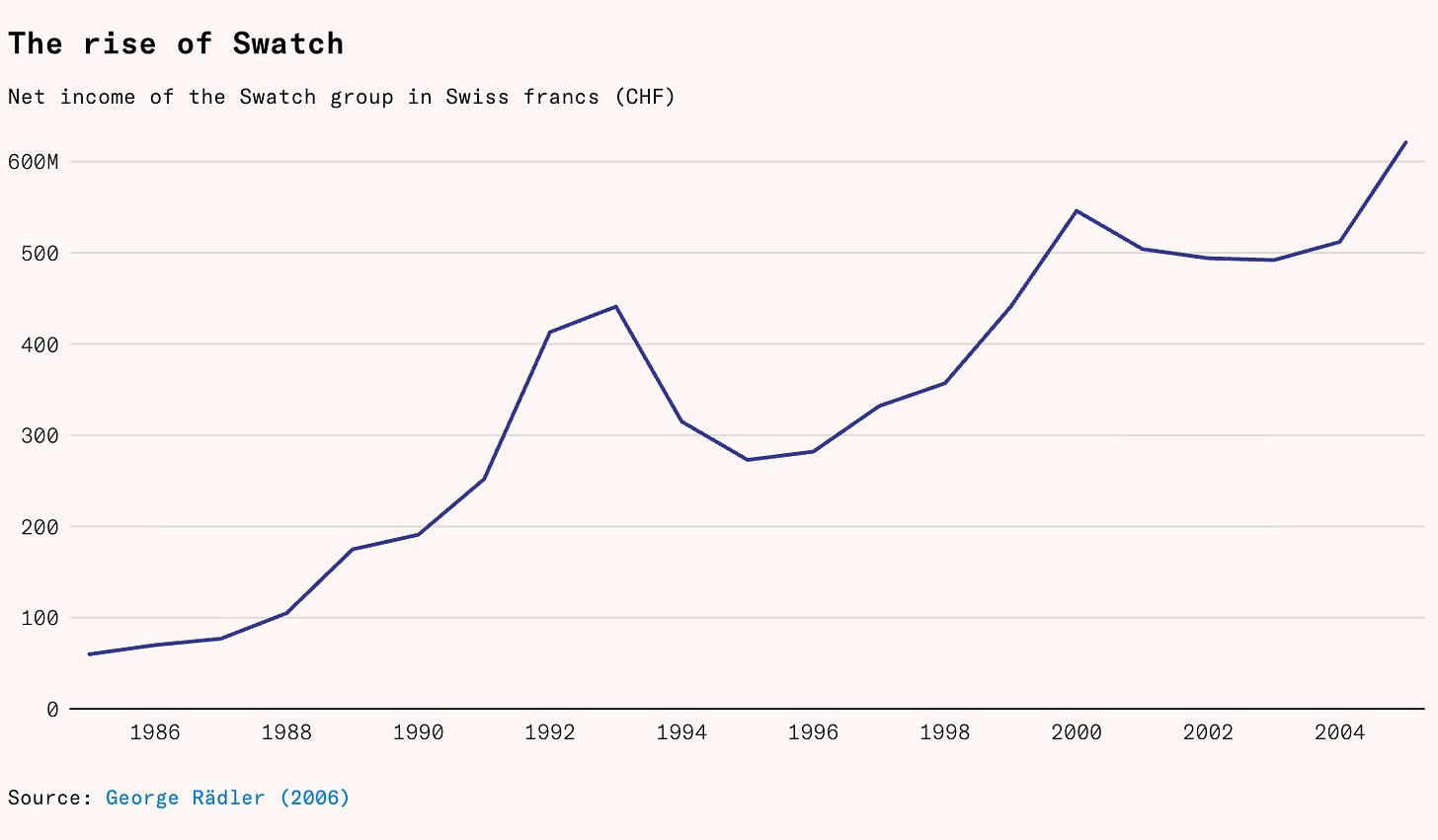
This became Swatch.
Not only had the Swiss made a better watch than the Japanese. But they had also turned it into a fashion accessory that appealed to all segments of the mass market.
What does this mean for the Great Indian FMCG Industry?
Apart from the obvious – double down on what you already offer and disrupt the new guys at their own game, here are three ideas for your playbook.
1.Technology foreshadows a decline that was any way inevitable
Lab grown diamond technology existed since 1954. The Quartz technology? Since the 1960s.
The technology that could disrupt you is already being tinkered with in some garage right now.
Chances are, that you yourself have a technology tucked away in a drawer somewhere. I call it Drawertech™. Dust it off. Breathe through the fear that ‘it will kill my business!!’ And test launch it.
3. What is value?
Quartz technology, instead of sending them to their grave, gave Swiss watch makers the opportunity to forge value in two opposite directions. One, luxurious, hand-crafted, artisanal. Two, fashionable, trendy, affordable at all price points. This was not done through advertising campaigns (which was De Beers’ main response), but through a fundamental re-engineering of the business model and operations.
How can you re-shape your business to reinvent value for consumers before they write you off?
2. Study history
I think one of the best ways to think more strategically is to read history – both business and otherwise. Because the problems you are facing now? Someone else has faced already. When you study their history, you can learn what to do from survivors, and what to avoid from the failures.
Sources: