
Legacy FMCG built their mass distribution capability from the ground up. But today, even to stay in the Red Queen Race, they need to master a new operating system – D2C and e-commerce.
There are two paths forward. You can build it internally. Or you can buy D2C brands and learn from them. Most companies are building in-house. A few, like Marico, ITC, HUL, are also buying D2C brands.
Colgate has chosen a third path. They are handing over Palmolive’s D2C and e-commerce flywheel to Bombay Shaving Company (BSC), while continuing to own product, quality, supply chain and offline trade.
This is a bold move. I applaud it. I have a prediction and a question.
My prediction is that the deal is less about managing e-commerce operations, and more about polishing and reshaping Palmolive into a brand new D2C, aka digital-first brand.
My question is that Colgate is borrowing BSC’s tacit knowledge, but how will they build this as a capability for themselves?
Let’s dive in.
A timeless deity in a young shrine
The week the Colgate-BSC partnership was announced, I read about the Ise Jingu shrine in Justin Oberman’s newsletter. I couldn’t help but see the metaphorical similarities.
The Ise Jingu shrine in Japan is more than 1,300 years old, but also 20 years young.
Every 20 years, carpenters build an exact replica of the Ise Jingu shrine right next to the original one. Then, in the dead of night, they transfer the deity from the old shrine to the new.
The old building is dismantled, its timber is sent to shrines all over the country to be used as gateposts and supporting beams.
In 2013, the shrine was rebuilt the 62nd time.
For the 62nd time, the deity remained the same, the shrine timber changed.
This, dear readers, is the perfect metaphor for the dilemma the Great Indian FMCG industry faces, now that the four horsemen have disrupted how products are made, sold, and bought → What’s the deity that remains unchanged and sacred? Vs. What must be rebuilt otherwise it’ll rot?
It’s this dilemma that Colgate’s Prabha Narasimhan is trying to resolve for Palmolive.
Modern FMCG has become a one-deity, many-shrines business.
General trade, modern trade, e-commerce, quick commerce, D2C, are the various shrines through which the deity and consumers connect. All these channels matter, and must operate simultaneously.
The brand is the deity.
By nature, FMCG products are commoditised, so, brand is the deity.
A brand is nothing but the place it occupies in a consumer’s mind. Simply put, “When X Happens, I Think of Palmolive.”
A brand, like deities, remains timeless, as long as belief in it is transmitted from one consumer to the other, from one generation to the next.
In situations where there is no distinctive association of ‘X’ with a brand. No belief. No memory. There may be awareness, but very little brand pull.
While our belief in deities is deep, inter-woven into our culture, and is an integral part of our identity, most brand beliefs don’t run as deep. A brand has to re-earn belief constantly. (Especially in a competitive environment that sprouts new D2C brands everyday.)
Brand belief can be re-earned in many ways.
You can tap into a present-day consumer or cultural insight to keep it relevant,
you can ‘polish’ it by relaunching it,
you can even ‘give it new clothes’ through a new visual identity.
But you can’t abandon it.
I think Colgate and BSC will definitely do the first two, by making Palmolive a spikey, digital-first brand.
Here’s why.
Solve for X. When X happens, I think of Palmolive.
Let me speak for myself. Palmolive is not the first (or the fifth) brand I think of, when I think of body wash.
I have used it in the past (maybe 10 years ago). I loved the fragrance then, and the purple one was my favourite. But somehow, I have not been compelled to buy it again.
So, for me, the X is just fragrance. The brand does not have a deep meaning structure for me.
What about you?
Is Palmolive’s e-commerce flywheel broken?
A quick scan of BSC and Palmolive products on Amazon reveals that both have the e-commerce nuts and bolts in place.
Both have thousands of people rating them 4+. (overall, it looks like Palmolive even has higher ratings than BSC).
Both offer similar discounts.
Both are available on quick-commerce.
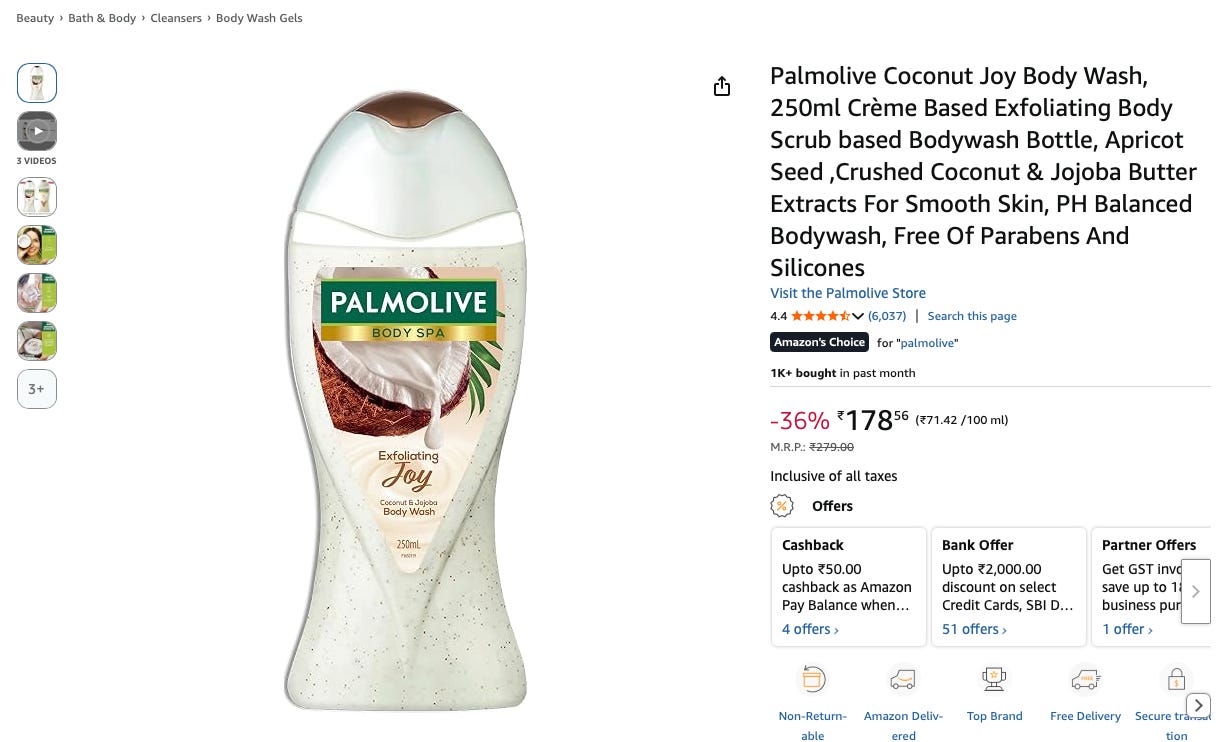
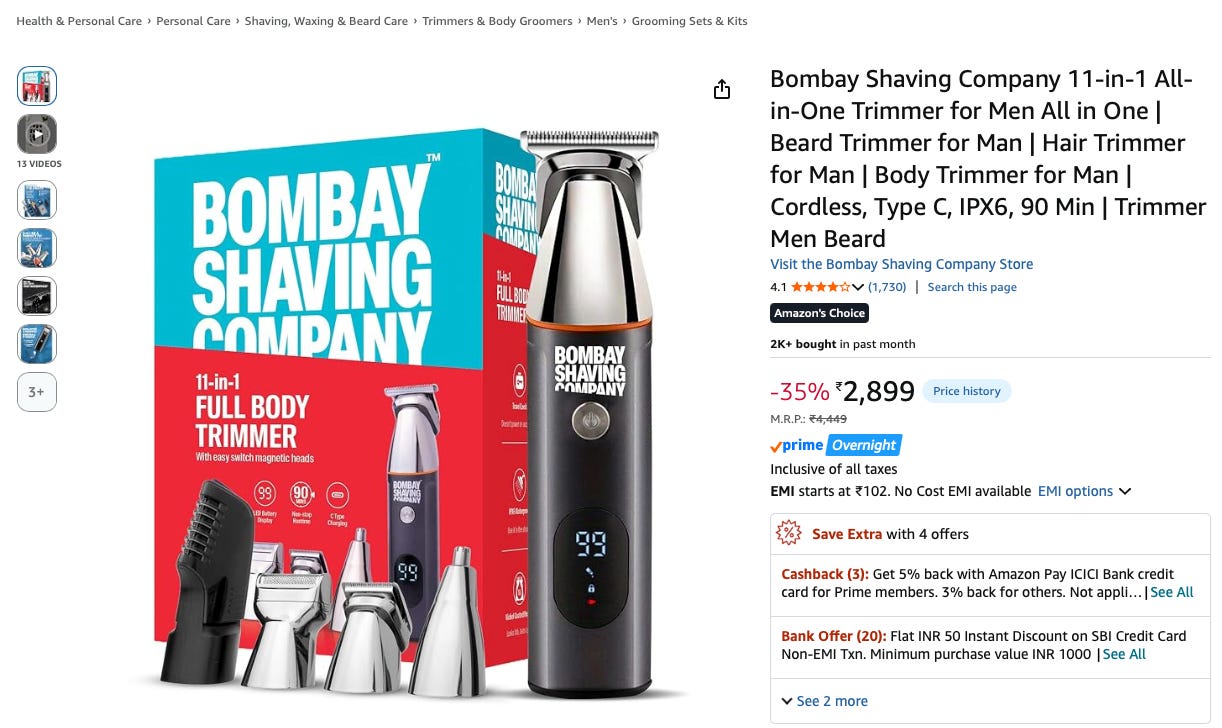
No, Palmolive’s e-commerce flywheel is not broken.
Do people search for Palmolive? Are there enough repeats?
For strong established brands like Palmolive, consumers type the brand name into the search bar. If that were happening at scale, there would have been no need for this partnership.
Will the partnership work harder to generate trials? I think so, because if BSC have managed to do this for a relatively unknown brand, they must have some tricks they can apply to Palmolive.
Having said that, online flywheels generate trials easily, but repeats are difficult to engineer.
And there is only so much an e-commerce engine can do to generate repeats. Generating repeats is the work of a brand. To get consistent repeats online, you have to either have a spikey proposition, or be the trusted and familiar choice.
In my opinion as a marketer, (and experience as a consumer), Palmolive is a trusted familiar choice, but not at a scale that Colgate will be proud of.
To become a sizeable online brand, Palmolive will need to attract jaded online devotees. For which, it will need to don a new avataar and become a spikey, standout product + brand.
More D2C, less nuts and bolts.
E-commerce is simply a go-to-market operating system (which Colgate has mastered already).
D2C, on the other hand, is the art and science of building digital-first brands. Its is a system that works on a learning loop. One loop could look like this.
Social listening for trends and insight → Quick product innovation → Small batch size production → Launch → Make noise +Influencer campaign → Customer partnership conversations → Read the data → Learn why clicks did not lead to buys → learn why repeats did not happen → Tweak/ Abort/Repeat
The loop itself could change. You could start with Reddit. Or offline research. Or you may choose to not do any research at all.
Building a D2C business is a dance between judgement and data. It’s learned through failure. It gets embedded into the system and team working together. In short, it’s tacit knowledge. This tacit knowledge that BSC has, and Colgate, by its own admission, lacks.
That’s, why, I can predict with confidence that BSC’s assignment is to convert Palmolive into a digital-first brand. Not to only manage e-commerce operations.
Now the question.
How will Colgate internalise BSC’s brand building capability?
By handing over the deity, (Palmolive brand), to the extent that it will need to be morphed for D2C, Colgate shows how serious it is about winning.
But it’s not going to be easy in the short-term. The pain will only be worth it if Colgate learns from BSC.
Will it?
The coordination tax.
Colgate retains product, manufacturing, supply chain and offline trade. BSC will own the judgement on what to change in the product, Colgate might have to first approve, and then build it.
Colgate will manage the brand for offline, BSC for online. The two teams will need to synchronise discounts, calendars, inventory, media, communication and visual identities.
D2C flywheels turn on speed. Legacy FMCG flywheels turn on processes and hierarchies. I can only imagine the coordination tax this will take; and the culture shock that might erupt when a startup collides with a 100-year old company.
I have experienced this firsthand when I was running the Lipton Ice Tea business – a JV between Unilever and PepsiCo. Unilever owned the brand and the product technology. HUL sold Lipton Ice tea powder in modern trade and general trade. PepsiCo sold ready-to-drink bottles in its general trade and in the on-premise channel.
Sounds complicated? It was.
I followed two reporting calendars – one for PepsiCo and one for the JV. What was worse was coordinating trucks between PepsiCo’s godowns to Unilever’s distributors and vice versa, and navigating different softwares, paper trails, rigid ‘this is how we do its’ and jargon of two giants.
I spent 30% of my time managing logistics, meetings, and PPTs. Time that might have been better spent on the business itself.
My learning is that Colgate and BSC will need to manage everything with the precision of two trapeze artists mid-air, reaching for each other’s limbs.
Doing and knowing feed each other.
Each carpenter works on the Ise Jingu shrine maybe thrice in their lifetime. As an apprentice, as a builder, and then as a seasoned expert and teacher. This way, tacit knowledge passes from one generation to the next.
This knowledge is precious. Lose that, and you lose the shrine that houses the deity.
Capability can be taught. But tacit knowledge can only be learned through an apprenticeship model.
To carry the metaphor forward, Colgate is hiring BSC’s carpenters to build a new deity (Palmolive D2C brand) and a new shrine (applying their tacit knowledge of D2C brand building to the Palmolive context).
Tacit knowledge lives inside a system.
BSC have built judgement after navigating thousands of tiny decisions, learning from failures, and surfing multiple economic cycles.
How will Colgate learn this unless it embeds its people into BSC?
This is an important question, because the fascinating thing about tacit knowledge is that it does not live inside one person. It lives within a system.
Boris Groysberg researched1 more than a 1,000 Wall Street star analysts and learnt that their performance was correlated with the company they were in. When they changed companies, their performance dropped. Only those that moved with their entire team, or into a much better firm and infrastructure, performed better.
Hiring expert carpenters from outside is not the same as learning through apprenticeship.
Will BSC be a partner in the truest sense, or a hired contractor?
Success or failure will come down to the day-to-day working arrangements.
If the partnership’s ONLY focus is to get Palmolive to work. BSC might work at arm’s length, like a hired contractor. In this scenario, Colgate will continue to do what it does best – approvals, processes, hierarchies, year-long innovation timelines, and offline distribution. This will be a Strategy Blind™ move.
If instead, Colgate employees work out of BSC’s offices – share and learn and build together – and then come back to Colgate to apply their new found tacit knowledge, Colgate will be better off in the long run. This will be the real win.
Palmolive’s success as a digital-first brand will just be the cherry on top.
1 https://www.researchgate.net/publication/285931858_Chasing_stars_The_myth_of_talent_and_the_portability_of_performance