The Strategy Goldilocks Sentence

Reading Time: 6 minutesUnambiguous, meaningful and absorbent strategy sentences 10X your chances of success
When new technology dissolves old moats – Diamonds Vs. Swiss Watches

Reading Time: 6 minutesWhen technology shatters old moats, new moats must be built. Lab grown diamonds have dulled the sparkle of De Beers’ moat. in the 1880s, Japan’s Quartz technology disrupted the Swiss Watchmaking industry. But instead of sending them to their grave, it became an opportunity to forge value in two opposite directions. The diamond industry can learn from them.
Colgate is borrowing BSC’s D2C capability. What will be the real win?

Reading Time: 7 minutesIf Colgate can integrate the tacit knowledge that BSC brings to the table, it will be set up for success over the long term
The Strategy Eyesberg™

Reading Time: 5 minutesBelief+Aspiration+Choices+Ambition make a complete strategy. If you base your strategy only on what you see -> ambition, you will find yourself in an over-competed market.
When companies become kingdoms, they go strategy blind™

Reading Time: 8 minutesModern workplaces are like royal kingdoms. Leaders are like Princes, hoarding power. Employees are like courtiers, competing for Princes’ approvals. In all of this, the market remains under-served.
Why platforms are eating your margins

Reading Time: 4 minutesWhoever owns the scarce bottleneck captures value. In Rockefeller’s time, the bottleneck was transportation. Today, for FMCG brands, the bottleneck is attention. That’s why platforms are charging ‘toll’ and squeezing margins. But if you keep renting that bottleneck, you are not building a business.
You can’t financial engineer your way into growth

Reading Time: 7 minutesThe same financial instruments can build a demand engine like it did at Coca-Cola, or distract you from real demand creation like it did to Nestlé under Mark Schneider. The difference is in the lens – do you see like an operator, or like a money allocator?
Looks right but feels wrong: strategy vs. execution

Reading Time: 6 minutesExecution is ‘seen. Strategy is ‘felt’ That’s why the right conditions that allow for strategy to emerge are critical. I have tried to capture the look and feel of strategy vs. execution spaces, so you can self-diagnose.
Why the stay spiky or broaden paradox of D2C is a math problem

Reading Time: 5 minutesToo narrow and you don’t grow. Too broad, and you become undifferentiated. The way out is to ‘see’ the underlying invisible math and expand into the adjacent possible,
The model that explains why the Great Indian FMCG industry™ feels ‘stuck’
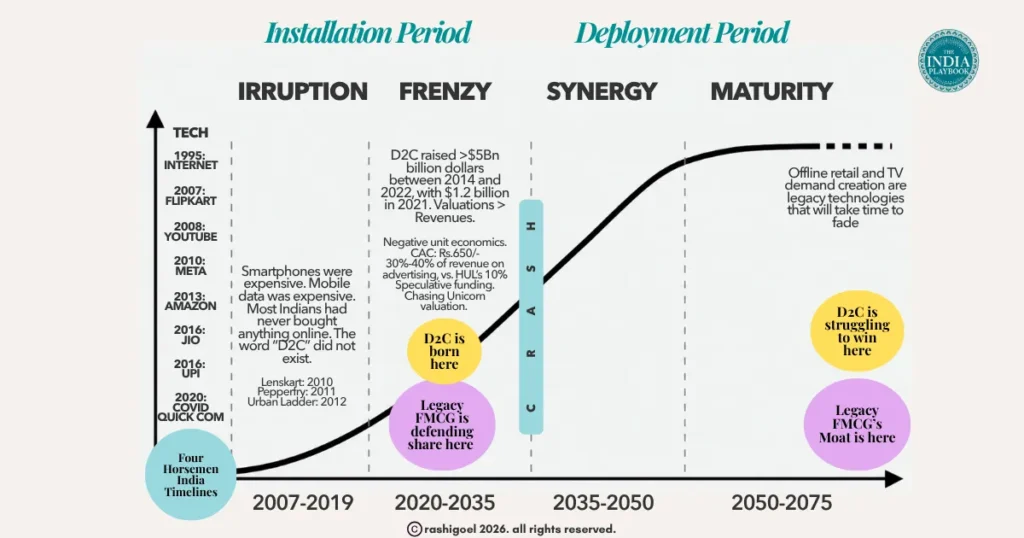
Reading Time: 6 minutesCarlotta Perez’s technological revolutions thesis that the industry is mid-cycle with playbooks that are still WIP. The only way to get ‘unstuck’ is to grow their own playbook from the ground up